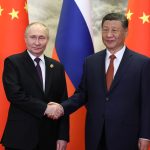
In an interview with Propastop, Tauno Tõhk, a researcher at the International Centre for Defence and Security, describes how Chinese state propaganda operates.
In Estonia, only Russian propaganda and disinformation attacks are widely noticed. However, in other parts of the world, the activities of the People’s Republic of China are also considered a serious threat—for example, in the context of influencing U.S. presidential elections. How do Chinese and Russian disinformation attacks differ?
Although both have quite a few similar elements in their toolbox, there is a distinct difference in how these tools are used. When discussing China’s manipulation of the information space, one important point to note is that disinformation (the coordinated spread of false or biased information) is only one part of China’s information manipulation. Equally significant is China’s effort to silence individuals and organizations outside its borders through various pressure tactics. This dual approach is further supported by actions aimed at increasing its footprint in the global information space and infrastructure. It is difficult to draw a clear line between China’s information manipulation and other forms of influence operations and external interference, as various tactics are often combined.
Unlike Russia, Chinese state media is still sometimes regarded as a credible source of information for Western media. In addition to the obvious issue of trustworthiness, this creates broader vulnerabilities, as China has repeatedly shown its willingness to use all lines of cooperation—media partnerships, academic collaborations, economic relationships—as tools for influence, including silencing dissent. In part, they leverage access to the large and appealing Chinese market. Additionally, China has been more restrained in its narratives directed toward Europe than toward the United States, which in turn has a lulling effect.
China, following a long-term communication strategy, has established media channels or social media channels in many countries that present Chinese propaganda viewpoints in the local language. Such channels have long been active in Finland and Sweden, so why hasn’t China set up a propaganda channel in Estonia yet?

The website of China Radio International is available in more than 50 languages, and for a time in the previous decade, Estonian was even among them. Currently, it is not. It’s likely that China allocates resources based on the size of languages and information markets, and additional human resources are needed, namely local partners proficient in the language, although this has become less critical with the advancement of translation technologies.
Often, Chinese media channels operating in some European languages, such as French or Spanish, are more targeted at influencing the information space of countries outside Europe that speak the same language – for example, in Africa and South America. These channels disseminate messages that discredit human rights, democracy, the West, and NATO. In the so-called Global South, there are countries that are much more receptive to Chinese propaganda messages.
However, in certain countries and when targeting specific groups, creating new media or social media channels is not always the most effective approach for China, as certain associations tied to China can reduce the impact of the message. To bypass this, China has started hiring foreign influencers who deliver the provided talking points as if they were independent.
Nonetheless, we can still observe systematic Chinese activities directed toward the West, even if their messages do not resonate well in Europe. As mentioned, China does not always use propaganda pressure to enhance its appeal; instead, it often aims to limit the expression of critical opinions about China.
Many countries attempt to improve their image in the world and spread narratives that align with their interests, and this in itself cannot be criticized. However, China is one of the countries that, in addition to developing its image, also deliberately spreads disinformation – such as various conspiracy theories. Why?
When positive narratives about one’s own country are combined with the spread of disinformation or intimidation, what would otherwise be legitimate activity becomes much more problematic. If you manage to silence critical messages about yourself or discredit independent sources with disinformation, it potentially creates more space for propagandistic messages.
For example, Chinese state propaganda has spread conspiracy theories that originally came from Russia, claiming that there are secret U.S. laboratories in Ukraine conducting biological experiments. China propagated this conspiracy theory to deflect responsibility for the COVID pandemic. They also resurfaced this theory after the full-scale war in Ukraine began, indirectly justifying the war initiated by Russia. Additionally, China’s state-led propaganda system has spread conspiracy theories such as Ukrainians being Nazis or that there are Nazis fighting within the Ukrainian defense forces.
At the same time, China balances its propaganda messages quite well in the sense that, unlike Russian propaganda, it does not always present clear falsehoods that are easy to verify and immediately debunk. Rather, Chinese messages are often subtly biased, aiming to undermine the credibility of the West in the global audience by, for example, discussing the illegality of sanctions against Russia. China’s long-term goal is to systematically reduce global support for Western countries, democratic values, and fundamental rights.
In addition to propaganda, China systematically suppresses messages it finds unfavorable, creating more space for the amplification of its own messages. Therefore, when viewed in combination with other information manipulation techniques, China’s propaganda cannot be considered an innocent activity.
What does this intimidation and pressure look like?
The range of methods in this field of information manipulation is very broad: from intimidating and harassing individuals to pressuring companies and organizations using negative or positive economic incentives. Individuals, including human rights activists, journalists, or scholars living in Europe who raise or investigate critical topics related to China, have been personally threatened.
In addition to individuals, foreign companies and organizations are also deterred from raising certain issues. In terms of cooperation agreements, this can mean threats to cut off funding from the Chinese side or restrict access to the Chinese market. In more extreme cases, diplomatic sanctions have also been observed – for example, the Berlin-based think tank Merics, which focuses on China studies, has been sanctioned by China.
For example, in the consumer boycott launched in China against the popular retail chain H&M, which was prompted by the company’s references to human rights violations in cotton production in Xinjiang, social media channels linked to the Communist Party played a significant role. The involvement of the party and the state in consumer boycotts organized in China against Western companies has also been noted before, estimated to occur in at least a third of such cases. This type of experience likely means that the specific company, as well as other Western firms that have “learned from” H&M’s experience, are less likely to raise human rights issues in the future. This, in turn, leads to a decrease in the amount of honest information available about China.
The preceding discussion illustrates that, in addition to directly silencing targets, China’s broader aim is to foster self-censorship in the West. If a company dependent on the Chinese market or a university collaborating with China knows that it is better not to raise topics problematic for China or not to include a China-critical academic in a panel discussion because the Chinese side might react negatively or even threaten to end cooperation, then the goal has been achieved without any clear evidence pointing to China’s direct role in the decision.
In any case, both direct pressure and the cultivation of self-censorship represent an explicit attempt to limit freedom of expression on topics critical of China, even in democratic countries.
I have personally encountered Chinese individuals living in Europe and the U.S. who have to worry about their safety even in these countries seriously. If a Chinese person living in Europe or the United States publicly criticizes China, there is a risk that their family members living in China will be threatened, forcing critical voices to fall silent.

It was only in 2022, thanks to the report by Safeguard Defenders, that it became widely known that China had quietly established over a hundred so-called police stations in foreign countries, including in Europe. On the one hand, these stations assist Chinese citizens living abroad with administrative matters, such as renewing driver’s licenses. On the other hand, they serve as tools for monitoring and pressuring Chinese citizens living abroad, with one of their goals being to surveil and pressure dissidents.
In the lead-up to the recent U.S. presidential elections, Russian disinformation campaigns worked in support of Donald Trump, who ultimately won. Could it be said that China, on the other hand, acted against Trump, given his threats to launch a full-scale trade war against the import of Chinese goods?
Observers generally agree that it is currently difficult to discern a strong preference from China for one candidate over the other. The stance taken on China in U.S. trade policy does not differ significantly between the two presidential candidates and, according to analysts’ expectations, will remain unfavorable for China regardless of who wins the elections. China certainly prefers maximum stability and predictability, even in bilateral relations on a negative trajectory. Additionally, a U.S. that pursues isolationist policies would be most suitable for China.
When discussing China’s pre-election information operations and influence activities, one trend noted in Washington amid prevailing negative sentiment towards China is a shift in focus from presidential candidates to congressional and more local-level candidates to shape a more favorable political environment for China in the long term. Since lower-level elections attract less attention, it is easier for information operations to go unnoticed there. Additionally, more targeted disinformation campaigns can potentially have a greater impact.
In the case of China’s information operations on social media, there is an increasing tendency to notice attempts at inciting societal conflict and destabilization similar to those used by Russia—an element that has only appeared in Chinese information operations in recent years. Even before the presidential elections, attempts by China to manipulate Americans and encourage people to take to the streets to protest have been discovered. For example, in 2023, a Chinese communications agency hired American activists through a U.S. freelance job portal to organize protests—in one case against the U.S. government’s ban on goods produced in Xinjiang—without the participants having any idea that they were acting on behalf of China.
However, when it comes to social media manipulation, Russia has been much more effective in Western societies than China. The prevailing assessment of Chinese information operations has been that they have mostly not been able to break through to Western audiences. This assessment is now changing, as we are seeing the development and diversification of Chinese digital information operations, particularly with tactics aimed at concealing China as the original source of information. This includes hiring foreign influencers, using the podcast format, or creating news sites that appear unrelated to China.
Starting in November, the European Union’s tariffs on electric vehicles produced in China will take effect. It is likely that protective tariffs on other Chinese goods will follow. How does China respond in its propaganda to the escalation of trade relations with the EU?
One of China’s main recent claims has been that the EU’s talk of excessive production capacity and subsidies for electric vehicle manufacturers in China is false and based on incorrect information. China has made similar statements in response to previous EU measures, such as human rights sanctions or legislation aimed at countering economic coercion.
However, in recent years, we have generally seen that China’s messages directed at the EU have been consistently more conciliatory than those aimed at the U.S.
When China has criticized EU sanctions against Russia, in many cases these decisions have been presented as actions taken under U.S. pressure. This likely aims to create a rift between allies, distancing the U.S. from Europe. China’s propaganda also interprets the discussion of creating EU strategic autonomy primarily not as a defense of the EU’s strategic interests, but as a move away from the U.S. and a reduction in criticism towards China. It can be believed that as long as there is still hope of influencing the tariffs, China will maintain a rather soft tone in its messaging. It is also typical for Chinese state media to amplify the voices of parties that align with China’s stance, such as certain European car manufacturers who have spoken out against the tariffs.
Has there been a shift in public communication within the European Union regarding China, where it is now increasingly presented to its citizens not as an important trading partner, but as a dangerous political and economic rival?
This shift began in 2019 when EU countries adopted the framework document on EU-China relations. In this document, China is defined through three dimensions: one is as a cooperation partner on global issues such as climate change or resolving international conflicts. The second dimension is economic competition, and the third dimension is China as a “systemic rival.” The latter term describes how China promotes different values, governance practices, and a different vision of the international order.
Especially after the outbreak of the war in Ukraine, the pendulum in EU thinking and rhetoric has swung significantly towards viewing China as a systemic rival. This is why, for instance, European Commission President Ursula von der Leyen has made more critical statements about China in recent years. Additionally, various measures have been initiated, driven by China’s actions, ranging from monitoring foreign investments to mitigating risks in the EU’s competitiveness due to dependencies on China for different categories of goods.
Of course, perspectives vary from one member state to another. Relations with China involve different motivators, as each member state seeks to develop its economy and preserve jobs, leading to bilateral actions that sometimes conflict with the EU’s common policy. Hungary clearly stands out at one extreme with its distinct stance on both China and Russia. Nevertheless, overall, the attitude of EU member states has become more critical, and on several key issues, they have managed to present a united front.
It could be said that when China attempted to intimidate other countries with very aggressive behavior—such as the wolf warrior diplomacy—it was effective in the Global South but rather counterproductive in European societies.
I also argue that awareness of the risks associated with China significantly increased in Western societies as a direct result of China’s own actions. Attitudes toward China in Europe have become more negative, and China’s image has deteriorated.
This shift largely began during the 2019 Hong Kong protests, but it was especially pronounced during the COVID-19 pandemic when Chinese diplomats spoke very aggressively on social media and spread various conspiracy theories. China sought to send the message that if others did not act in ways that pleased it, strong Chinese countermeasures would follow.
There is a concept known as “authoritarian inflation.” According to this concept, narratives about the power of an authoritarian state eventually start to take on a life of their own and act as an autonomous method of deterrence. In practice, this means that despite a more critical stance toward China, we occasionally still encounter attitudes suggesting that certain actions should not be taken because they might provoke China and trigger a response. Such a mindset itself indicates that China, through its aggression, has partially achieved its goal by normalizing this way of thinking.
Tauno Tõhk is a researcher at the International Centre for Defence and Security, who studied in Wuhan, a city that gained notoriety during the COVID-19 pandemic, and investigates China and Chinese influence operations.