Author: Marian Männi, freelance journalist living in Chișinău
In the referendum on joining the European Union, every fifth vote was paid for by the Kremlin. Nevertheless, the referendum narrowly passed. Thanks to Moldovans living abroad.
Yesterday was one of the most important days in Moldova since its re-independence. The people were asked if they are pro-European or pro-Russian: “Do you support changing Moldova’s constitution to join the European Union?” Citizens could answer “yes” or “no.”
The result was very close, with only 50.5% confirming their support. As former Moldovan Foreign Minister Nicu Popescu said: “Even a narrow victory is still a victory.” He recalled that Sweden joined the European Union with only 52% support, while in 2003, 66.83% of Estonians voted in favor of joining the European Union.
Although we are celebrating here in Chișinău today, the situation was grim late last night. Initial results showed that only 46% of voters supported joining the European Union. Meanwhile, long lines formed outside polling stations at Moldovan embassies in the United States and Western European countries. People came from afar and waited for a long time.
In London, even one of Moldova’s most famous oligarchs, Veaceslav Platon, lined up to cast a vote for his partner, who is running for president (former TV journalist Natalia Morari, however, received less than one percent of the vote in the presidential election). Platon is under investigation in Moldova for money laundering and bank fraud, and is therefore hiding in London. Immediately, tensions flared. Other people waiting in line shouted at Platon, calling him a thief, and became irritated that he only spoke in Russian.
About 77 percent of Moldovans living abroad supported joining the European Union, and by morning, the results were already looking much more hopeful thanks to them.
By midday, it was clear that Moldova had overcome the main obstacle on its path to the European Union — the public’s indecision about its future. The European Union has promised to reward this country of 3.5 million people with a support package worth more than a billion euros.
My family was attacked with a fake video
“Although the joy in homes was great, the streets were quiet. Much has been endured in recent months. There have been cyberattacks. Just a few days ago, parliament members’ inboxes were hacked, and humorous excerpts were shared on social media to ridicule the country’s leading politicians.”
There have been disinformation campaigns. Our family also fell victim to one. A video was published of my husband, the Minister of Economy, Dumitru Alaiba, where he is shown sitting at a table covered with cocaine lines, surrounded by naked women. The video editors had pasted his face onto the body of a man with an unusually long and carefully shaved chest. The text accompanying the video claimed that this is how the minister spends his work trips in Estonia. On the table were cigarette packs and drinks with Russian labels, which are not sold in Moldova or Estonia. So, the result was sloppy and unconvincing, but there are always those who start to feel the gnawing doubt — maybe he has something to hide?”
An unknown pro-Russian lawyer wrote to me, offering to represent me in court in case of a divorce. He emphasized that, as a woman, it must surely be hard for me to endure infidelity.
In addition, there were other disturbing comments. The distribution of the video was well-coordinated and even reached Ireland, where people found it amusing to giggle about how Moldovan politicians do their work. Of course, it’s easier to bear slander when you know it’s not true. But still, it’s ridiculous! In Moldova, Russian channels are constantly being shut down, both in the media and on social networks. As a result, much of the propagandists’ activities have moved to TikTok and Telegram.
We are eagerly waiting to see what the Kremlin will surprise us with next. Some believe that large waves of protests will come, as most citizens living in the country did not want to join the European Union. This would be a great excuse to bring back the paid protesters to their positions.
Many foreign journalists are wandering around the city. Some are looking for protests to capture good footage. So far, no marchers or flag-wavers have been seen yet.
The second round of the presidential election will take place in two weeks
Yesterday, presidential elections were also held in Moldova. The current pro-European president, Maia Sandu, did not achieve the desired result of more than half the votes (she received over 42 percent). This means that in two weeks, citizens will be called to vote again—this time between two candidates. Her main rival, the pro-Russian Aleksandr Stoianoglo, garnered 26 percent of the votes in the first round.
Sandu has already called on the public to mobilize. In her speech, she stated that in the recent elections, around 300,000 votes were bought — which means about every fifth vote!
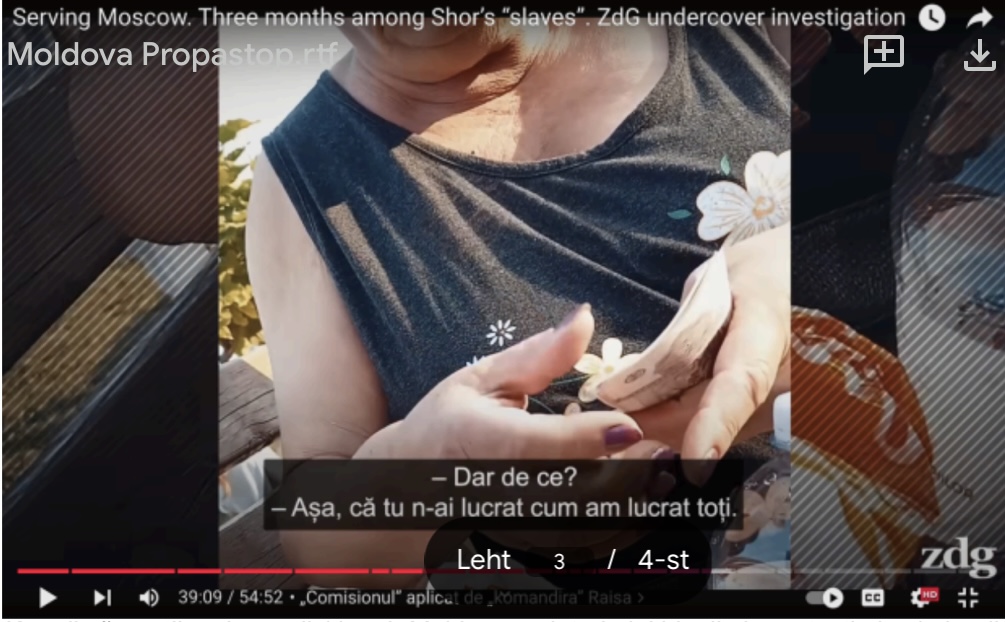
Screenshot: Investigative journalism publication ZdG (Ziarul de Gardă).
According to Moldovan police, around 130,000 Moldovans are involved in a well-organized network aimed at influencing the election results. Students and pensioners were paid monthly salaries starting from 50 euros to protest and make the “right” pro-Russian decision at the ballot boxes.
Young Ziarul de Garda journalist Măriuța Nistor infiltrated the network and was quickly promoted to a key role, where her job was to withdraw and distribute money to the “protesters.” Nistor filmed and recorded everything over the course of several months. Just before the elections, one of the country’s strongest investigative editorial teams published her revealing video report. Moldova’s police have also released a significant amount of information about the Kremlin’s activities in Moldova.
I asked in the villages, “Who decides Moldova’s future?”
One major point of debate today is whether citizens living outside Moldova should have a say in the country’s internal affairs. Is it right that if the majority of Moldovans within the country do not want to pursue a European direction, this clause is still added to the constitution? If emigrants want to have a voice, they should come and live here.
Maybe they will come back? I’ve heard that many were waiting for the referendum results to decide whether to return home or not. People don’t just leave without reason. Today, I drove around the villages to get a sense of what’s happening in rural areas. A delightful grandmother, shovel in the soil and a pink scarf tied tightly over her ears, declared, “Yesterday, I voted for the European Union. I want there to be enough jobs and good salaries here in Moldova so my children don’t have to leave.”
According to her, Moldova already has European prices. She receives a minimum pension: 130 euros per month. Therefore, she and her husband grow their own food and ferment grapes to make wine. For the winter, their cellar is already filled with lard and pickled tomatoes. Chickens and ducks provide the meat they need. Sometimes their children send extra money.

Photo: Marian Männi.
Most of the village’s young people have left. The street where the grandmother grew up is quiet, winding through abandoned houses.
At the same time, opposition politicians are using television to spread fear about a massive exodus that they claim will happen if Moldova joins the European Union. A million Moldovans have already left. It’s hard to believe that the pensioners in Moldova’s villages will suddenly start leaving en masse to begin new lives in France or Italy. Instead, the hope is that a vote in favor of the EU will bring friends and children back home.
Therefore, yesterday’s vote wasn’t just about the constitution or a political worldview — it was an effort to reunite families. It was the hope that maybe houses will once again be filled with people, and suddenly, the sound of children’s laughter will be heard in Moldova’s villages, as it was two decades ago. Back then, corruption and the poverty it brought drove Moldovans away from their homes — the very things the Kremlin is now trying so hard to bring back to Moldova.
Marian Männi is an Estonian journalist who has been living and working as a freelancer in Chișinău in recent years.