The Kremlin’s bundle of narratives, including special operations, denazification, stopping the persecution of Russians, protecting the “Russian world,” the “historical truth” about the non-existence of Ukraine, fighting against the aggression of the collective West, etc., changes according to the circumstances, but now it has come down to playing with open cards, to stating your true intentions. The reason for this is probably to secure a better position in future negotiations.
Recently, Russian-language Deutsche Welle, among many other news channels, wrote that Russian President Vladimir Putin compared the current proposals for peace negotiations in the war with Ukraine to an attempt to pressure Russia to give up its conquests. “It is impossible for us to give up the conquests that we have accomplished in a year and a half. This is unthinkable,” Putin said, adding that such an understanding of realities exists both in Ukraine and among the Western elite.
The objective is clearly formulated
Putin is supported by his right-hand man, former Russian President and current Deputy Chairman of the Security Council Dmitry Medvedev, who stated in his Telegram post that Ukraine has no right to exist separately from Russia and that continued resistance to the Russian armed forces will end in the destruction of the Ukrainian people.
“Ukraine’s existence is deadly and dangerous for Ukrainians themselves. And I’m not just talking about the current Bandera political regime. I am talking about absolutely any Ukraine. […] They will finally understand that life in the great commonwealth, which they do not particularly want now, is better than death. Their deaths and the deaths of their loved ones. And the sooner Ukrainians understand this, the better,” Medvedev wrote.
Olexander Scherba, an ambassador with special powers from the Ministry of Foreign Affairs of Ukraine, announced via the social media network X in response that this is Russia’s most genocidal statement to date. In essence, Medvedev says that not only soldiers but also the civilian population will be killed if resistance to the aggressor state continues.
It is important to note that Medvedev’s words have not been taken seriously by decision-makers for a long time, because it is not believable that he would have the power to implement them. Rather, he amplifies Putin’s message to such heights that Putin’s own words begin to sound more reasonable. If you look carefully, you can also find a desire for peace behind Medvedev’s words, only in an even more blatant perspective than Putin’s.
Putin and Medvedev are not the only ones who have started making sharper and clearer statements. According to Robert Fico, the new prime minister of Slovakia, to end the war, Ukraine must compromise and give up part of its territory. “What do they [Ukrainians] expect? That the Russians are leaving Crimea, Donbas, and Luhansk? It’s unrealistic,” Politico quoted Fico’s words, which essentially copy Putin’s aforementioned statement. Another notable supporter of Putin in Europe has been Hungarian Prime Minister Viktor Orban for a long time, Viktor Orban, whose iron-fisted Hungary blocked €50 billion in EU aid to Ukraine in December and is blocking the start of EU accession talks.
In essence, they are all pushing the cart in one direction: so that when the war ends, Russia will have at least the currently conquered territories.

Why are Putin’s words important?
The essence of Putin’s “openness” lies in the fact that he threw a message to the world public more forcefully than ever before: the aim of attacking Ukraine was to annex its territories, it is not possible to give up the conquered territories, if there are peace talks, the West must take this into account. The earlier narratives, which were intended to veil the real intention, are not absolute and never have been, because they are pragmatically designed to achieve certain objectives. In the current case, it can be summarized as follows: control over certain areas has been achieved to a sufficient extent, and if the situation requires that it is necessary to sit down at the negotiating table, then the achieved absolute power must be retained. Anything less would most likely mean the fall of Putin’s regime.
The new narrative does not necessarily lead to abandoning the used talking points, it complements the old and established constructions because the Kremlin’s propaganda formula does not require the narrative to be justified and completely truthful. Rather, it is the skillful cocktail of truth and fiction that has been the main form of Moscow’s propaganda activity.
Let’s remember that before, the Kremlin has tried to hide its real intentions in a network of half-truths and outright lies – full-scale military activity has been consistently called a special military operation, and the invented justifications vary from the protection of Russia and Russians to denazification and demilitarization. But since February 2022, when Russia launched a full-scale war against Ukraine, the Kremlin’s narrative has evolved, new talking points have been added, and emphases have shifted.
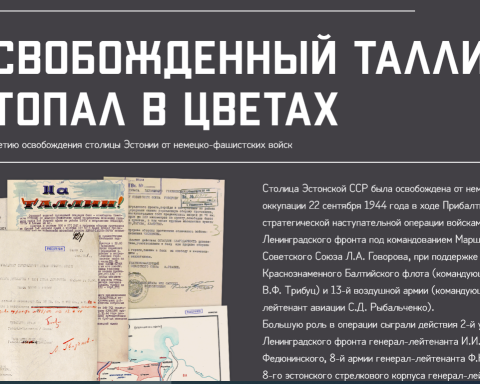
After the failure to capture Kyiv, it was no longer useful for Moscow to talk about fighting the Nazis. As Foreign Policy writes, it would have been too embarrassing even for Kremlin propagandists, besides, it was not very believable that the Nazis are in power in Kyiv when the president is a Jew, Volodymyr Zelenskyi. The Kremlin even commissioned a separate survey, which revealed that most Russians did not understand the term “denazification” and did not believe it applied to Ukraine (except for the Azov Volunteer Regiment). If in the first half of 2022 Nazi talk was mandatory for high-ranking officials and the mass media, then in the second half of the year even one of the loudest nightingales in the Kremlin, news anchor Vladimir Solovyov, stopped adding the slogan “Denazification is inevitable!” to the end of each of his Telegram posts.
The Nazi theme was replaced by blaming the West for pulling the strings in Ukraine and inciting war. In this context, however, it is important to note that the Kremlin did not directly say – at least not in the main talking points—that the goal was to conquer Ukraine.
In resuming full-scale military action almost two years ago, Moscow repeatedly asserted that it had no interest in occupying Ukrainian territory. “We are not going to impose ourselves on anyone,” Putin said. Therefore, Putin’s words mean a change in the narrative.
What conclusions can be drawn from this?
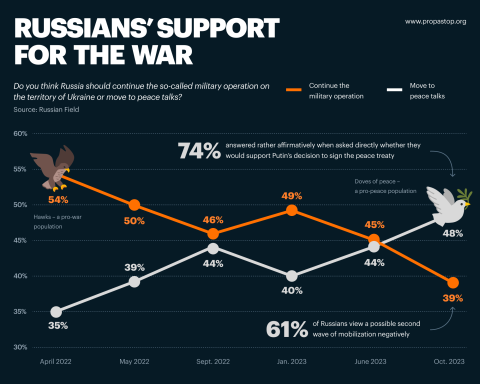
The longer the war lasts, the more difficult it will be for Ukraine, Western countries, and Russia, which Putin at the helm hoped to end quickly as a blitzkrieg. His promise to the Russians that nothing will change in their homes is getting harder and harder to keep.
The more time goes on, the more the war affects the average citizen of Russia. Ukraine has recently repeatedly demonstrated its ability to attack Russia deep in its inland territory, or the ability to bring military action to Russian soil. Western sanctions, the lack of trained soldiers, the increasingly anxious mothers of soldiers, etc., also put pressure on Putin to make peace or truce – but only if it is possible to present it to the Russian public as a victory, as the fulfilment of goals. It is therefore reasonable to believe that Putin’s statements are most likely motivated by a desire to sit at the negotiating table from the best possible position. First of all, it means leaving the regions of Crimea, Donbas, and Luhansk under their (influence) power, saving them from the “harmful” influence of the West, and taking a step forward from the “stagnant” West in the global struggle.
In December 2023, Putin said that Russia was willing to hold peace talks with Europe and America on the future of Ukraine. Also at this meeting, he pointed out that Russia does not intend to give away what is “rightfully his.” At the same meeting, Russian Secretary of Defense Sergei Shoigu said that Russian forces have laid 7,000 km2 of minefields and 2,000 km of anti-tank ditches in Ukraine and installed 1.5 million tank barriers. According to Shoigu, the West should review the Ukrainians’ wish list instead of supporting the counterattack that betrayed their hopes. Here is a visible discouragement that it is extremely difficult to recapture the occupied territories and a recommendation to leave them to Russia.
If we summarize the above, behind the new narrative is the desire to secure a stronger position in the peace negotiations that will come sooner or later in the most important part, which concerns the restoration of Ukraine’s integrity or the ceding of part of the territory. As the Chatham Trust think tank confirms, at the moment, peace negotiations would be more useful, especially for Russia, which has already put its ‘new territories’ to work for its economy. It also explains Russia’s narrative of playing loose cards – setting the baseline for negotiations.
Work has begun to achieve real goals
On the background of such theoretical statements, step-by-step action is also being taken on the ground, although not so blatantly.
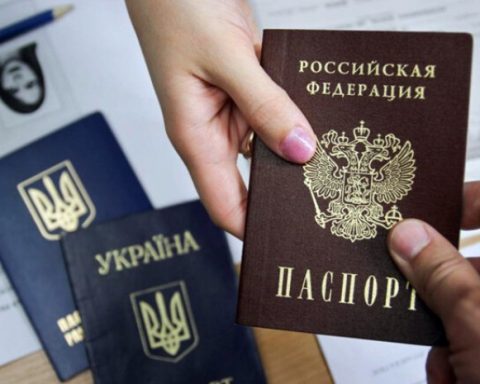
For example, the authorities in Russian-occupied Luhansk officially banned all Ukrainian-language textbooks and teaching aids in schools, and even all Ukrainian-language books must be removed from libraries. Leila Zotova, Deputy Minister of Education of the Luhansk “People’s Republic,” sent such an order to all educational institutions, including universities, the Kyiv Post wrote, confirming the authenticity of the letter leaked via Telegram. At the same time, the Russian Language Olympiad was announced in Luhansk.
In a presentation to Putin, the Russian Minister of Education informed Putin that Moscow would give 1.3 million Russian-language books to the “new regions” and that a uniform school system based on the Russian model would be introduced, in which the Ukrainian language would have no place. While Russia previously accused Ukraine of cultural genocide against Russians in eastern Ukraine without providing evidence, it is now clear that this propaganda is borrowed from Nazi Germany’s Goebbels toolbox: blame others for what you do.
In a recent speech to Russian regional leaders, Putin spoke about how Russia is exploiting the usurped areas of Ukraine. In 2024, according to him, Russia will grow more than 143 million tons of grain. “But if you take into account the new territories, then it’s going to be plus four million, the total will be 147 million,” Putin said.
All these point to Moscow’s real plans for Ukraine, which promise nothing but destruction to Ukrainians. The starting point of the peace negotiations and the expected playing field there are therefore of decisive importance. The unity of the West in ensuring the territorial integrity of Ukraine, which Russia is trying to destroy with all its means, and which is increasingly apparent from within the European Union, is not only the guarantor of Ukraine’s sovereignty but also the key to the future.
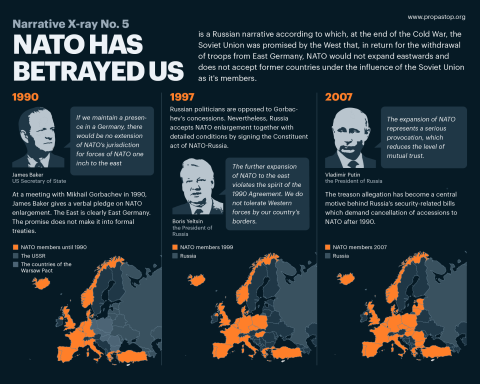
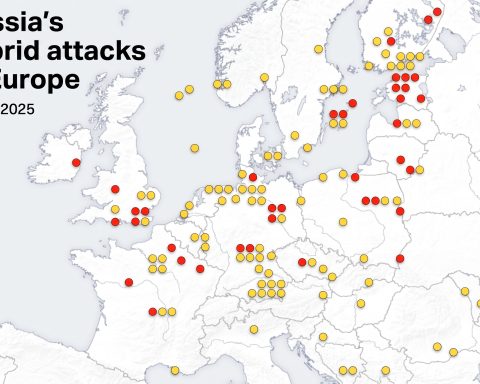
The infographic was created by Propastop’s editors.