Authors: Annika Arras, Helen Tammemäe
The war in Europe and tax policy have led to growing public concern about the security and economic situation. Together with Miltton, we investigated Estonian social cohesion in these turbulent times.
Social cohesion is an important cornerstone in the protective barrier that shields us from crises – other key elements of this barrier include a robust economic system, a stable government, the absence of conflict and corruption, low levels of poverty, and strong human rights protections. If any stone in this protective wall begins to crumble, the whole structure is at risk of collapsing.
A Norstat survey commissioned by Miltton shows that the war and tax policy have not left Estonians unaffected – concerns about security and the economy are dominant in society. The survey revealed that 74% of respondents experience strong negative emotions due to the global situation, 69% believe that the world is headed in the wrong direction, and 68% feel despair about the current state of the world.
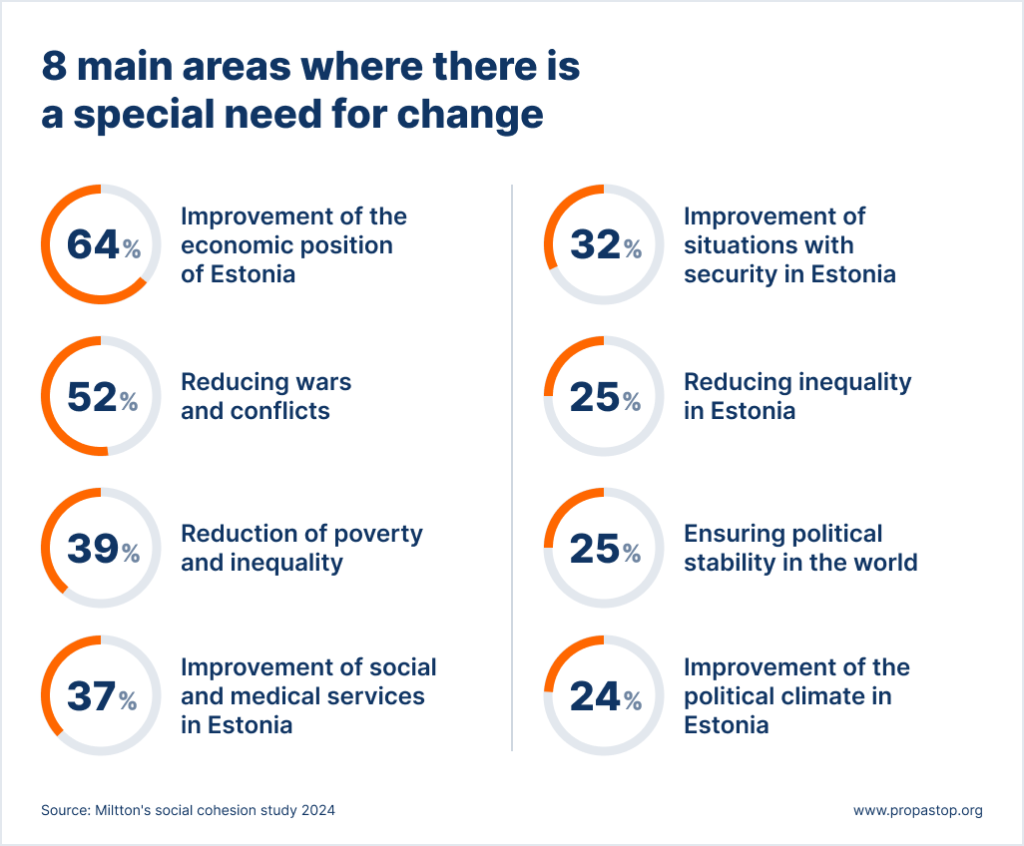
We compared the very negative attitudes that have emerged in society with the long-term research project “Me. The World. The Media” by the University of Tartu’s Institute of Social Studies, where it can also be observed that the share of positive evaluations increased during economic growth and decreased during times of economic crisis.[2]
Growing Uncertainty
Thus, pessimistic moods currently dominate society – Estonians are frustrated by the media’s focus on negative news, and tax policy further fuels these negative emotions. Notably, criticism of the press comes from respondents regardless of their political affiliation or worldview – both liberals and conservatives accuse the media of being excessively biased. In a situation where journalism plays a key role in shaping a unified understanding of global events within society, this is a dangerous trend.
Only 8% of Estonians experience positive emotions towards the current public debate. Very negative and rather negative emotions dominate 48% of respondents, while 40% remain neutral. The older the age group, the more likely they are to feel negative about the public debate. Deepening conflicts and polarization, however, open the back door of society, allowing easy access for propaganda and misinformation.
Who Creates Social Media Content?
It doesn’t help that although 57% of respondents use Facebook once or multiple times a day to follow public debate, only 7% create content on social media themselves, and 13% share content created by others. Nearly 60% of respondents prefer to observe the societal debate on social media from the sidelines or don’t participate at all, avoiding engaging in discussions. Additionally, 46% agree or strongly agree with the statement that people deliberately misunderstand one another.
Considering how many respondents use social media to follow public debate and how few actually create content, the inevitable question arises: in whose interests is the content that people predominantly consume on these platforms dictated?
Yet, There Is Still Something That Unites Us
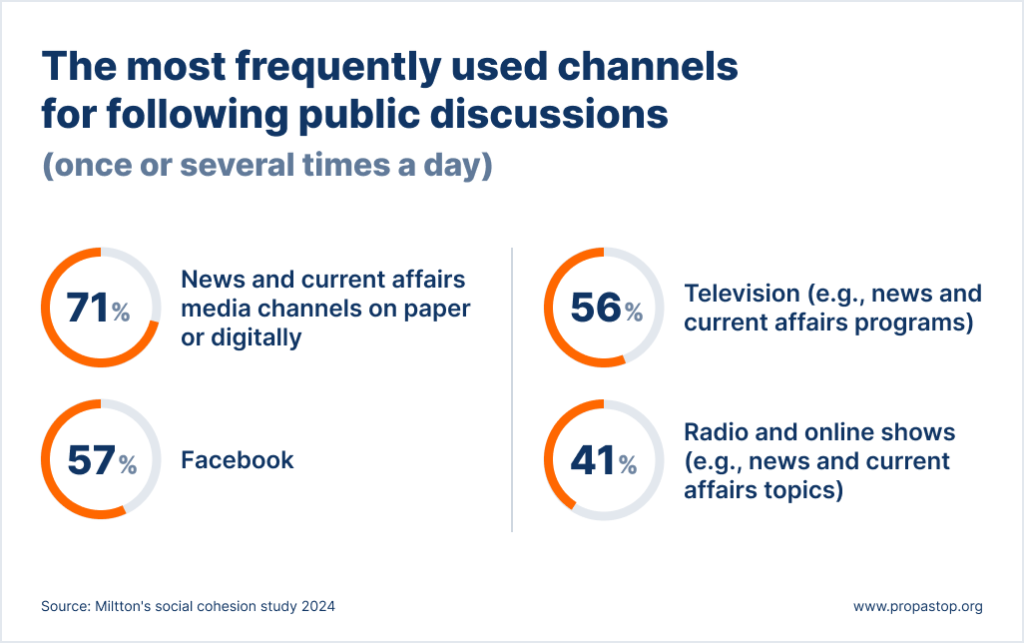
Despite the challenges, 57% still find public debate predominantly interesting, and the most commonly used channels for following it (once or multiple times a day) include, in addition to Facebook, news and current affairs media channels (71%), television (e.g., news and current affairs shows) at 56%, and radio and podcasts (e.g., news and topical issues) at 41%. Trust in journalism remains high, and 65% of respondents see free media as a source of hope for a better future.
People value civil discourse over confrontation and slander, with balanced argumentation and fact-based discussions still held in high regard. Discussion programs and in-depth explorations of issues help balance the negative news landscape.
Although only about a fifth of respondents participates in public debate through the media, 41% are more or less motivated by the global situation to engage with important issues. Most (24%) feel that doing good and helping others is motivating, and what matters most is what happens on a human and everyday level. Estonians find hope in the goodwill of their fellow people and in shared efforts.
What is most important is one’s own community—whether it’s family, coworkers, or another group. When participating in public debate, Estonians primarily engage in conversations with friends, family, or acquaintances, as well as in discussions at school or work. From the open responses in the survey, it’s clear that when there are many stressors in the external environment, people find hope in spending time with loved ones and in noticing and appreciating small joys.
The resilience of social cohesion in Estonia, therefore, depends on people’s social ties and trust in journalism. Misinformation poses the greatest threat to those who have lost trust in local media and whose social connections have weakened, whether due to loneliness, job loss, or other forms of deprivation. In a difficult economic situation, the challenge is how to prevent the growth of inequality in Estonian society and how to provide people with a sense of security and perspective for the future. It is crucial to find a shared narrative that fosters a sense of unity and helps us stand together even in challenging times.
[1] More than a thousand respondents aged 18 to 60+ participated in the survey. The study was representative in terms of age, gender, and region, and the survey was conducted by Norstat.
[2] The share of positive evaluations increased during economic growth, with the highest positivity observed in 2005 among the survey years. The share of positive evaluations decreased during the economic crisis, as reflected in the 2011 survey results. In the years of recovery from the crisis (surveyed in 2014), the evaluations slightly improved.