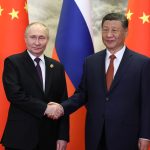
The Russia topic is stirring strong emotions on Chinese social media. While China’s official media presents Russia as a close partner and strategic ally, Chinese social media also contains sharply anti-Russian attitudes. These negative narratives draw on historical confrontation and territorial disputes, creating an image of Russians as greedy and untrustworthy. Russia’s war against Ukraine has only deepened these views and led some Chinese users to question Moscow’s value as a strategic partner. The fact that anti-Russian narratives are tolerated on China’s otherwise tightly controlled social media suggests that they are useful to Beijing in one way or another.
Russia’s Negative Image on Chinese Social Media
In 2018, Beijing and Moscow agreed to “tell each other’s stories well.” State media outlets on both sides of the border began aligning their strategies and narratives. Today, Chinese newspapers can reproduce Moscow’s talking points with almost word-for-word precision. The result is clear: for many Chinese people, Russia has become the most valued international partner, a noble comrade-in-arms in the struggle against United States “hegemony.”

Russia and China are geopolitically in the same boat. Many Chinese people believe that Xi Jinping considers Vladimir Putin his friend and that the partnership between the two countries has “no limits.” In Beijing bookstores, various biographies of Putin are on sale, praising the Russian leader’s wisdom and iron grip. It is no coincidence that the same strengths are often attributed to Xi. In online articles and comment sections, one often comes across slogan-like cheers such as “Putin is powerful” and “Russia will win either way.” Putin has become the figurehead of his country, shaping Russia’s overall image among Chinese people. Beyond Putin, Chinese users also like to tell admiring stories about Russia’s military and economic strength, and about its supposedly inevitable victory on the front in Ukraine.
A closer look, however, shows that Russia’s image among Chinese people is far from flawless. If one speaks to locals or digs through the vastness of Chinese social media, Russia-critical narratives begin to appear. Their main emotions are anger and a desire for revenge, and their main driving force is historical hostility.
Russia as a Historical Adversary
The expansion of the Russian Empire into the Far East is well known to Chinese people. Beijing’s official historical narrative, from school textbooks to museum exhibitions, portrays China as a victim of colonialism. Russia plays an important role in this story. Although the victimhood narrative is gradually being replaced by one that celebrates China’s power, the humiliation experienced in the 19th century is unlikely to disappear from collective memory anytime soon.
The Russian Empire took advantage of the weakness of the Qing state (1644–1911) and expanded its territory at China’s expense. Many believe these lands should rightfully belong to China. After the return of Hong Kong and Macau to the People’s Republic of China, Russia remains the only colonial power that has not returned the territories it seized from China at the time.

It is also believed that Russians are inherently greedy and warlike, respecting only the right of the stronger. In this view, Russia’s historical expansionism is not merely the stubbornness of individual rulers, but a defining feature of the entire state and people. “Greed is engraved into Russians’ bones,” one commenter states. Such remarks create the impression that Russia’s foreign policy behavior is unchanging over time and rooted in a permanent desire to expand its territory and influence. Some of the most critical views even compare Russia to Japan, which is regarded as the most hated adversary in China’s recent history. Russia’s actions in Ukraine are also interpreted as a continuation of the same pattern: where Russia once expanded at China’s expense, it is now trying to expand in Ukraine.
In addition to greed and militarism, Russians are also seen as untrustworthy. In 1858, Russia overturned the Treaty of Nerchinsk (1689), which had until then served as the foundational document of the Sino-Russian border. Today, disputes over border treaties are used as evidence to argue that Moscow does not respect agreements. This image is often extended to the Russian national character as a whole. In comment sections, Russians are described as dishonest people who break their promises. These traits stand in opposition to values highly prized in the Confucian cultural sphere, such as honesty, trustworthiness and a sense of duty. As a result, Russia is perceived not only as a historical and geopolitical threat, but also as a threat to the Chinese cultural sphere.
Russia as a Weak and Worthless Ally
Another group of negative attitudes criticizes Russia’s military and economic weakness. Several authors argue that Russia’s development is held back by its geography, dependence on natural resources and inefficient system of governance. The harsh climate and scattered population make the country’s modernization difficult. Russia’s war against Ukraine has only deepened these assessments. Some commentators go so far as to predict the downfall of Putin’s regime and the imminent collapse of the state.
Russia is also criticized for its inability to stand by its allies. Armenia and Syria are cited as examples. When the Assad regime fell, “all Putin could do was grimace,” one commenter says. From this, critics conclude that Moscow’s value as a strategic partner has declined and argue that China, too, should no longer tie itself to Russia. Some internet users even believe that cooperation with Russia harms China’s international reputation and goals. The war in Ukraine has become an important test of Russia’s capabilities, and in the eyes of many critics it has exposed Russia’s true face: “If Russia cannot even defeat Ukraine, then it is no longer Russia.”

Conclusion and a Look Ahead
When analysing negative narratives about Russia, it is important not to forget that the overall Chinese view of their northern neighbour remains overwhelmingly positive. Yet behind the official rhetoric and positive slogans lies a far more contradictory public opinion.
Now that Moscow’s offensive in Ukraine is struggling and China has become the stronger economic power, many believe the time has come for revenge. Slogans such as “let’s take back all the lost territories!” and “Russia’s border must retreat west of the Urals!” can be heard. The question of territorial integrity is extremely important to Chinese people, and the territories taken by Russia have become, for some, a symbol of national identity.
Although such views may not be dominant, Chinese society is divided on the Russia question. These disagreements appear not only between different people and social groups, but also within individual mindsets. No one’s worldview is entirely coherent, and people are capable of holding very different, even contradictory narratives at the same time. The same applies to Chinese people. A visitor to a Beijing bookstore may praise Putin’s firm rule one moment, and the next curse Russians as the most untrustworthy people on earth. In online comment sections, angry and contradictory opinions collide.
In addition to clashing beliefs, many people are confused and do not know what or whom to believe. Instead of taking a firm position, many prefer not to involve themselves in such complicated issues at all. In China, as in other authoritarian states, this is a common way of dealing with politically sensitive topics.
One thing, however, is clear: under the ashes, the fire is still smouldering. If the Party were to change its position on Russia one day, Chinese propaganda institutions could easily turn generally positive views into negative ones and transform an old partner into a new enemy. The foundation for this has always existed in Chinese collective memory. In other words, the China-Russia partnership is not based on deep social trust or shared values, but on pragmatic necessity, which will be discussed in the next post in this series.
Although it is too early to speak of the collapse of the Russia-China partnership, Western countries do not have to sit back and wait for Beijing to change its mind. The negative narratives described above could become input for the West’s cognitive warfare arsenal, aimed at creating enough cross-border tension to make cooperation between the two authoritarian states socially unacceptable.