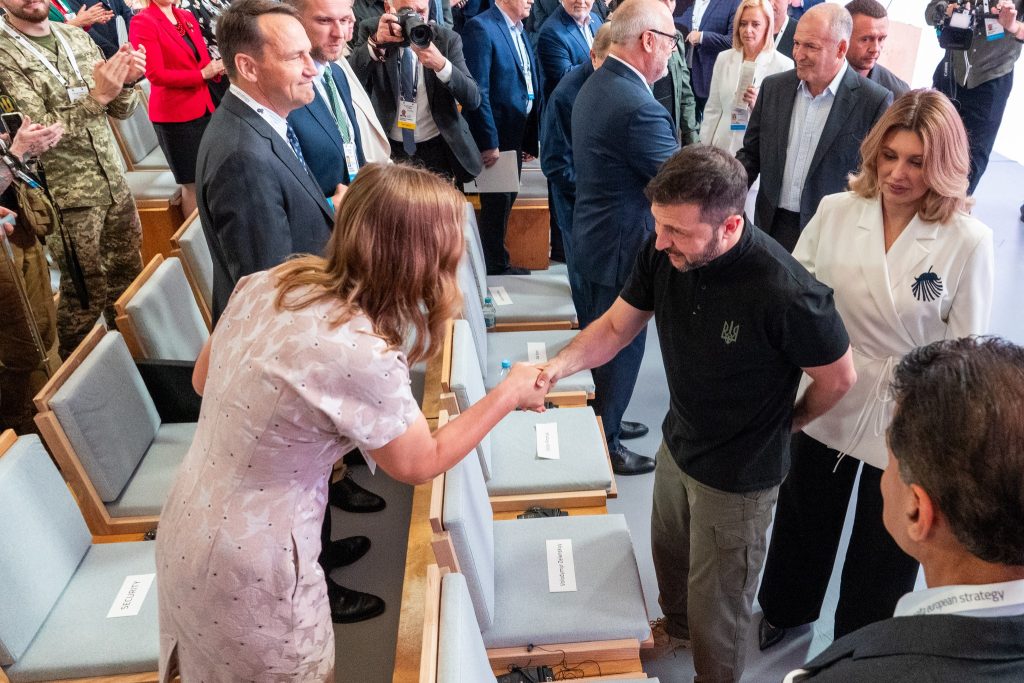
You just came from Kyiv, from the YES, or Yalta European Strategy conference, of which you are a co-organizer. This forum brings together people from all over the world who genuinely care about Ukraine and support the war-torn country. Based on this experience, how would you rate the current situation in Ukraine on a scale of 1 to 10?
“Exactly a year ago, there was a palpable sense of defiant anger, but the situation was rated a six. Now, I would say the rating is even a seven, because the attack on the Kursk region has significantly lifted the Ukrainians’ spirits.
In summarizing the Kyiv conference, we noted that, in words, many people stand firmly behind Ukraine. Then the Ukrainians come into the room and say that the Americans should allow us to shoot further, the French should finally provide the weapons that can reach that far. But every country has a thousand reasons why they can’t do what the Ukrainians are asking for.”
I have been spreading the report from our Ministry of Defense everywhere, “…which states that the Ramstein coalition has spent 0.2 percent of its GDP in support of Ukraine over the past two years. The well-known American journalist and political scientist Fareed Zakaria published this figure on his website, as he felt it was very important to show that, in reality, we are not doing much.”
The Ukrainians are currently trying to convince their partners that their defense industry’s production capacity today is 20 billion euros per year, but they are producing only for seven billion. Their message is: give us money, and next year they could produce weapons worth 30 billion.
Their lack of funds is immense, although the European Union representatives in Kyiv were very pleased that they had agreed to allocate 35 billion euros from Russia’s frozen assets. The Americans didn’t even have that to talk about.
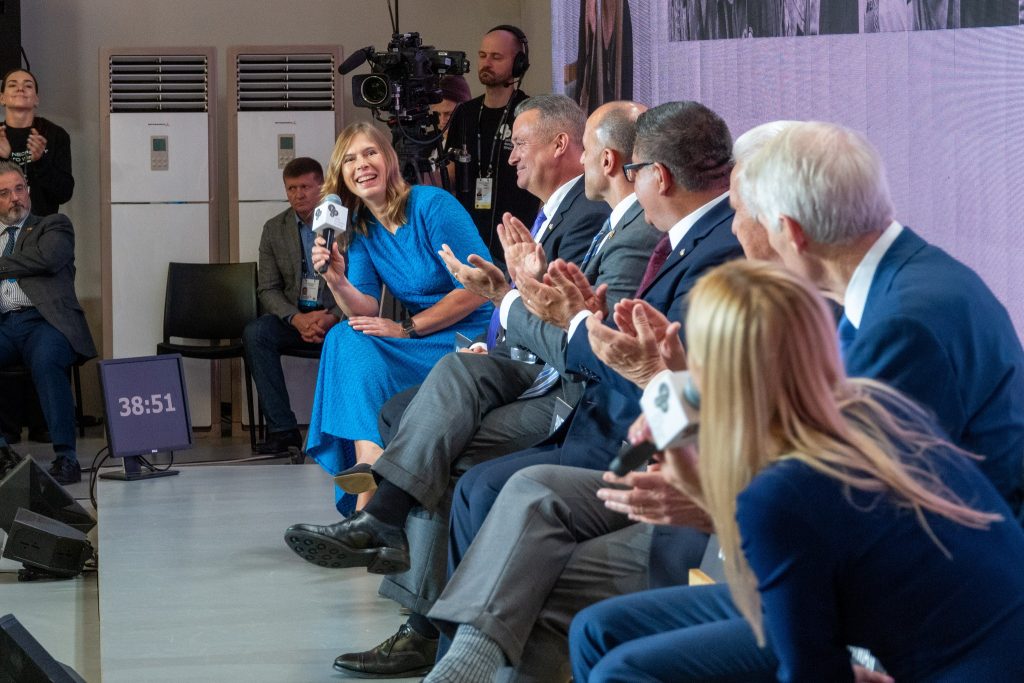
You led the panel at the YES conference titled ‘Will the U.S. still support Ukraine a year from now?’, which included five U.S. congressmen and former senators from both the Republican and Democratic parties. How do you personally answer that question?
That was one of the worst panels of my life. No matter what I tried to ask, the responses were filled with light humor and election-season rhetoric. Both the Republicans and Democrats came off weak. Everyone is concerned about whether the Democrats’ restraint will continue (after a possible Kamala Harris election victory) and where the Republicans will lean. On one side, you have President Donald Trump‘s former Secretary of State Mike Pompeo, who assures that (in the event of a Trump victory) Ukraine will get everything it needs to win the war. On the other side, there’s vice-presidential candidate JD Vance, who claims that Ukrainians are so corrupt that helping them is pointless.
I was finally forced to say, ‘Friends, an hour ago, when we started this panel, there were a few more Ukrainian soldiers alive than there are now.’
In the early summer of 2023, Ukraine intimidated Russia with the prospect of a major offensive, which ultimately failed, resulting in great disappointment both domestically and abroad. By the summer of 2024, Ukraine has been under heavy pressure in defensive positions, and communicatively, it has been like walking a tightrope. They had to ask for more help, but at the same time, they couldn’t let the impression form that such a weak country isn’t worth supporting. How do you assess the success of Ukraine’s communication?
I’m not sure that it was the Ukrainians themselves who raised the expectations for the counteroffensive last year, because there were plenty of generals from various nations loudly announcing the offensive. What has always bothered me is that we (the Western allies) spend half a year debating whether to give something or not. By the time American tanks reached the front last summer, the Russians had built such barriers in front of them that the tanks weren’t as useful anymore.
Right now, we’re having the same kind of discussions about how far Ukraine can shoot, and the Russians are making sure their equipment is positioned just beyond that line. In my opinion, it’s rather the allies’ communication that has been poor.
Regarding Ukrainian communication, it can be said that they almost always succeed tactically. When a relatively weak conclusion came from the meeting between UK Prime Minister Keir Starmer and President Joe Biden last week (about the use of Western weapons to strike targets on Russian territory), Zelensky immediately stated in Kyiv that he was going to President Biden with a victory plan for Ukraine. This was necessary because there are increasingly clear voices from America saying a peace plan is needed. In response, Zelensky talks about a victory plan.
The golden rule of crisis communication is that communication is centralized in one person’s hands for the sake of clarity. At the start of the war, the centralization of communication in President Zelensky’s hands was natural, but how effectively does the one-man show work in the eyes of Ukrainians two and a half years after the war began?
President Zelenskyy’s popularity has declined, but it remains above 40 percent, which is certainly not a bad result for an average democratic country. People are aware of the centralization of power, not only in terms of communication but also in other aspects, in the hands of the Zelenskyy-Andriy Yermak tandem, which is increasingly and more clearly controlling the country. This could make Ukrainians uneasy.
At the same time, the opposition’s messages to foreign audiences are very unified. For now, they are content with Zelensky leading the country, as he has managed to maintain strong communication, and he is not criticized for that in Ukraine.
However, this is a high-risk game. If, for any reason, Ukraine needs to use someone else as a spokesperson, there is no one in external relations who comes close to being on Zelenskyy’s level, and that risk remains unaddressed.
How well has Ukraine managed to maintain the initiative in international relations and promote its peace plan?
Not very well. Ukraine was unable to gather key figures for the peace summit in June, particularly noticeable was the absence of Joe Biden, even though he was just a short helicopter flight away in Italy the day before. In that sense, Ukraine’s first attempt wasn’t very successful, but they haven’t given up and continue to push forward.
The main issue with the peace plan is what initially seemed like an advantage—it covers a wide range of topics, from global peace to global food security. In reality, however, this multitude of priorities allows countries to agree on something minor while sidestepping the main issue: restoring Ukraine’s territorial integrity. The broad range of topics gave many countries a way to appear supportive of Ukraine’s peace plan, while avoiding commitment to the most crucial matter, and this diffusion of focus is a significant problem.
How should we assess the prevailing attitude in Estonia that each mention of the word ‘peace plan’ automatically equates to an intention to betray Ukraine?
“I was on a panel in Davos with the globally renowned economist Nouriel Roubini, who said that although we’ve given everything to the Ukrainians, the war has ended in a stalemate. Now, they have to make a deal with Russia.
I asked Roubini, what does ‘everything’ mean? He had no idea that this ‘everything’ only amounts to 0.2% of the GDP of the coalition countries supporting Ukraine over two years. This is one of the biggest communication errors we’ve collectively made—we believe we’ve given Ukraine a lot. As a result, it seems to us that since Ukraine can’t win the war, they should start making deals.
The Kursk operation had many objectives—to disperse Russian forces, embarrass Putin—but one goal seems to be that if Ukraine eventually needs territorial concessions, they will have something to trade.”
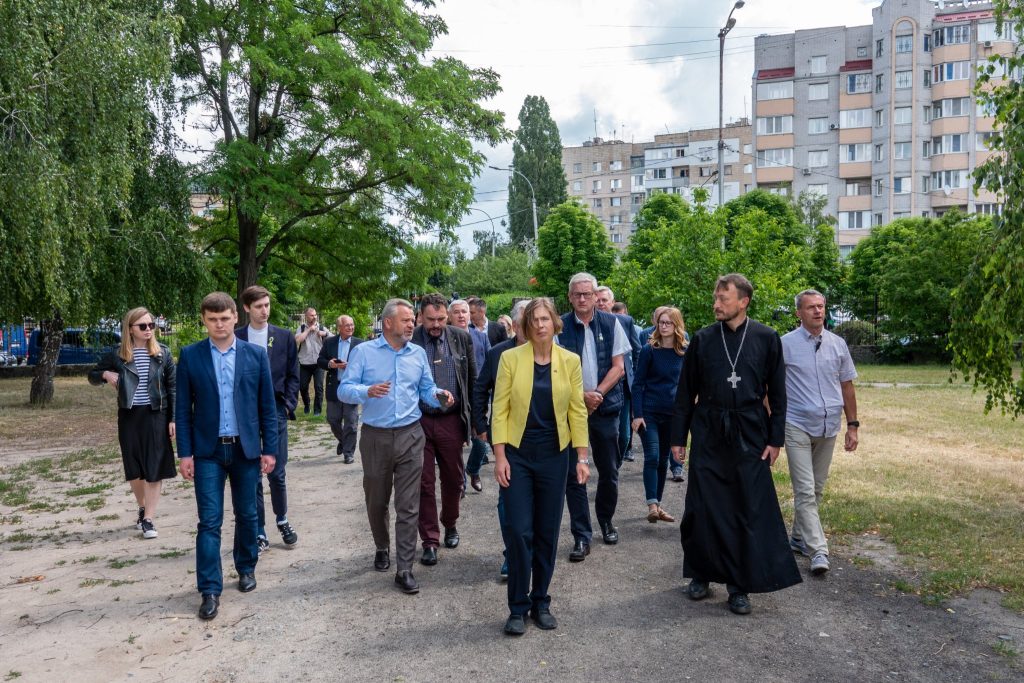
Photo: Mattias Tammet.
Russian media eagerly exploits video clips circulating on Ukrainian social media that show mobilization officers being cursed at in markets and on the streets as they check the documents of men of conscription age. These visually impactful examples cast doubt on the persistence of the Ukrainians’ will to defend. How do you assess this?
I overheard ordinary people in Ukraine discussing whether we should continue dying for those territories that have been reduced to ashes in the war, where no one will live anymore anyway. I don’t know how widespread this mindset is. However, there is no thought in Ukraine about whether to continue resisting.
Ukrainians have not been willing to discuss anything publicly other than the full restoration of territorial integrity. But that, too, is a communication problem. By now, this has become something that President Zelensky cannot back down from.
Perhaps only if—hypothetically—he goes to President Biden and presents an agreement with the U.S. president as a victory plan, part of which might include not fighting for everything anymore. Maybe in such a case, Zelensky could navigate out of this situation, validated by foreign allies. But for now, there is no public readiness in Ukrainian society to make any concessions regarding territorial integrity.
In war, in addition to financial and military aid, the communicative aspect is also crucial, as it can effectively deter the enemy. Could it be said that part of Ukraine’s problem is that the leaders of its most important partner countries— the USA, France, and Germany—are currently weak and are not fully utilizing their communicative potential?
Many people share this concern, but they don’t know how to address it. If we start every morning worrying that Putin might see our actions as an escalation, we are essentially showing hesitation from the start. I can’t imagine that during the Cuban Missile Crisis (under the leadership of U.S. President JF Kennedy in 1962) the same approach would have been taken.
It’s one thing for intelligence chiefs to discuss possible scenarios behind closed doors, and quite another for politicians to discuss them publicly. It’s becoming increasingly clear that we’ve largely drawn ‘Putin’s red lines’ ourselves.
The communicative success of the Kursk operation may be precisely that Ukrainian forces are operating on Russian territory, and no nuclear threat has materialized. The real communication issue is that we are giving Ukraine too little aid, and at the same time, we constantly appear indecisive.
In the public eye, it appears that France offers strong support to Ukraine, largely because President Emmanuel Macron is known for his rallying speeches. However, financially, the situation is the opposite—Germany has contributed to Ukraine’s aid eight times more. At the YES conference, France was represented by the recently resigned Prime Minister Gabriel Attal, who gave a passionate speech. During the panel discussion, no one asked Attal when France would contribute financially. As always, Germany had General Christian Freuding, head of the defense ministry’s planning department, present, and he doesn’t hesitate to say he’s ready to support Ukraine until Crimea is regained. But he is not at the level that carries significant communicative impact.
How does Ukrainian journalism function during the war? On the television landscape, there is essentially only one channel, produced collectively, according to a societal agreement. However, other media face ethically difficult choices: if they honestly report, for example, on corruption in the Ministry of Defense, it fuels the arguments of those opposed to supporting Ukraine. But if the press stays silent, the corruption continues unchecked.
Of course, these moral dilemmas are very real for journalists. Even independent journalists claim that when it comes to reporting or withholding military information, they are protecting war secrets.
However, independent journalists also say they do not hesitate to report on corruption cases. Although, I understand they are under significant pressure not to speak about corruption.
Recently, Ukraine’s intelligence chief Kyrylo Budanov, when discussing the timeline of the war, mentioned the year 2026. In your opinion, what is the purpose of offering such a time horizon?
I think Budanov is trying to create space and buy time, as everyone is interested in who will be president of the U.S. in 2025. Perhaps there will be positive progress in America in 2025.
But notice how Zelenskyy and Budanov’s messages can often differ. Zelensky is now going to Biden with a victory plan, while Budanov talks about 2026. Budanov seems to have a very independent way of thinking, and he might coordinate his messages with the president less than others. In my view, Budanov is very sincere and comes across as convincing— it seems to me that, in his mind, he is seeking more time and space.