
Photo: Eiko Lainjärv
Since one of Propastop’s goals is to enhance people’s knowledge in the field of psychological defense, we are starting a collaboration with the National Library to introduce specialized literature. In this section, RaRa’s media literacy specialist Kateryna Botnar will provide a more detailed overview of a selected work, and at the end of the article, you will find references to the latest publications on disinformation that have arrived at RaRa.
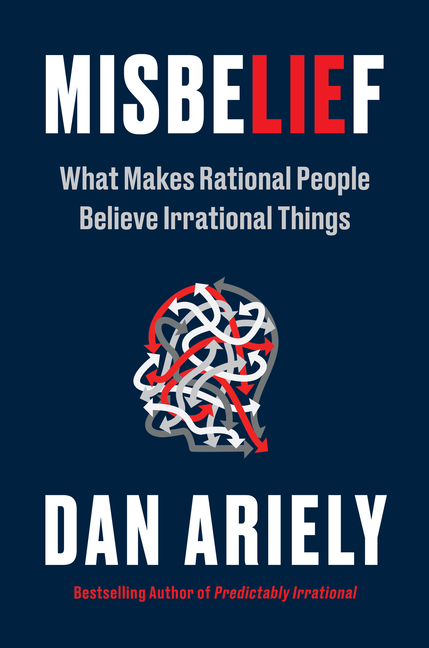
Dan Ariely „Misbelief. What makes rational people believe irrational things“
Kateryna Botnar, RaRa’s Media Literacy Specialist:
Imagine waking up one day and unexpectedly discovering that a terrible conspiracy theory about you is spreading, and several of your acquaintances have started to believe it. How is that even possible?
Dan Ariely describes exactly this type of experience in his book “Misbelief. What Makes Rational People Believe Irrational Things.” He seeks to understand people who create misinformation, those who produce supporting audio, video, and image materials, as well as individuals, including acquaintances and colleagues, who came to believe this misinformation, even when they personally knew the main character.
Who benefits from this? Ariely suggests that the people who created and spread misinformation about him are so-called “do-gooders,” who stumbled upon unchecked information and drew their own conclusions. It happens, right? But then they began spreading this type of information, often adding their own opinions. The attention they received on social media encouraged them to continue this kind of work.
To understand the gullible and the malicious?
The author suggests at least attempting to understand gullible people and feel empathy for them, which is not always the easiest task. However, by reflecting in this manner, we can gain a better understanding of why people are susceptible to being influenced by misinformation and what factors facilitate it.
According to Ariely, it is clear that misinformation and its more developed form, conspiracy theories, have become more personal—meaning the focus is increasingly on events we have experienced ourselves or people we personally know, and so on. Social media plays a significant role in this, accelerating the rapid and widespread dissemination of misinformation.
This made me think once again that social media and web users in general tend to be more digitally literate than media literate. Simply knowing how to use a device is no longer enough to ensure our peace of mind and critical thinking.
Dan Ariely broadens the meaning of misbelief, emphasizing that it is not just about accepting some false fact but rather a “perspective like distorted lenses through which a person sees, understands, and describes the world to others.”
You might ask — but what about personal beliefs? Don’t we know what is right and wrong, and aren’t some people more skeptical than others? Of course, skepticism is good when it is reasonable. It motivates us and drives us to explore the unknown.
Its distorted forms, however, manifest as constant doubt in oneself or everything around (reflexive mistrust, dysfunctional doubt). In simpler terms, Ariely says, this means that there comes a moment when people stop questioning a currently circulating narrative and start embracing and believing it. They begin to distrust almost everything that, for example, the media or the government says, and end up living with this persistent sense of mistrust.
According to the author, losing trust leads to distrust: for example, if we lose trust in one institution, the same pattern may repeat with another, and eventually, we trust no one.
In a sense, this creates a filter bubble that a person builds for themselves for various reasons and to which they remain loyal. The formation of a filter bubble is further supported by a scarcity mindset, which, according to a study, means that a person’s mental capacity diminishes when they have less money—in other words, when a person lacks resources, they are more likely to consume less information and reflect on it less.
Conspiracy Theory: The Continent of Australia Doesn’t Exist!
I don’t believe in conspiracy theories, but some of the ones mentioned in Ariely’s book truly stunned me: for example, the claim that the continent of Australia doesn’t exist. Several theories emerged during the COVID-19 pandemic and have remained popular to this day.
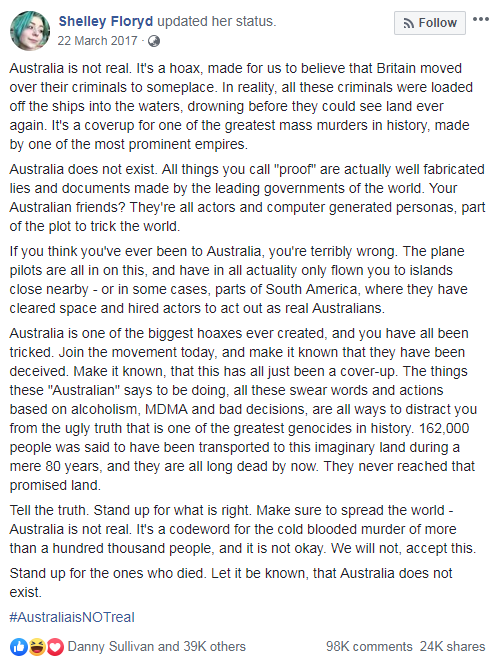
Photo: screenshot.
To spark more interest in the book, I’ll mention a few other topics it addresses: the psychology of hatred, beliefs and the challenges associated with them, the defensive mindset, confirmation bias, and more.
The author argues that people search online for what they already believe or want to believe, but instead, they should challenge their beliefs and viewpoints—by reading what contradicts their opinions and meeting people who hold different views. This is because cognitive biases start from a hypothesis that people seek to confirm. Ideally, the search for information should be free of bias.
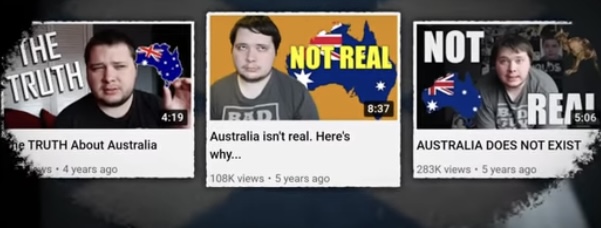
Photo: screenshot.
A biased search can lead the seeker to new social or social media groups whose members share a similar worldview—groups that welcome them. Belonging is a powerful feeling, and being excluded from a social group can prompt, among other things, the creation of a new filter bubble and the search for new social groups.
In summary, Dan Ariely’s book is enlightening, intriguing, and personal—through his own experiences, he attempts to explain the reasons behind believing in misinformation, the layered complexity of this belief, and at the same time, teaches us to empathize with people who follow such principles, even if we often struggle to find common ground with them.
Check out the discussion with Dan Ariely on the topic of the book.
The book can be borrowed from the National Library of Estonia, as well as through MIRKO.
Check out other new books on disinformation available in the RaRa collection:
Becoming a critical thinker : a workbook to help students think well in an age of disinformation
Conspiracy theories : a reference handbook / Jeffrey B. Webb
Among the trolls : my journey through conspiracyland / Marianna Spring
The rise of the algorithms : how YouTube and TikTok conquered the world













































