
In Russian-language social media, propaganda spreads through numerous videos, some of which are quite peculiar – some are extremely polished and refined, while others seem rather homemade.
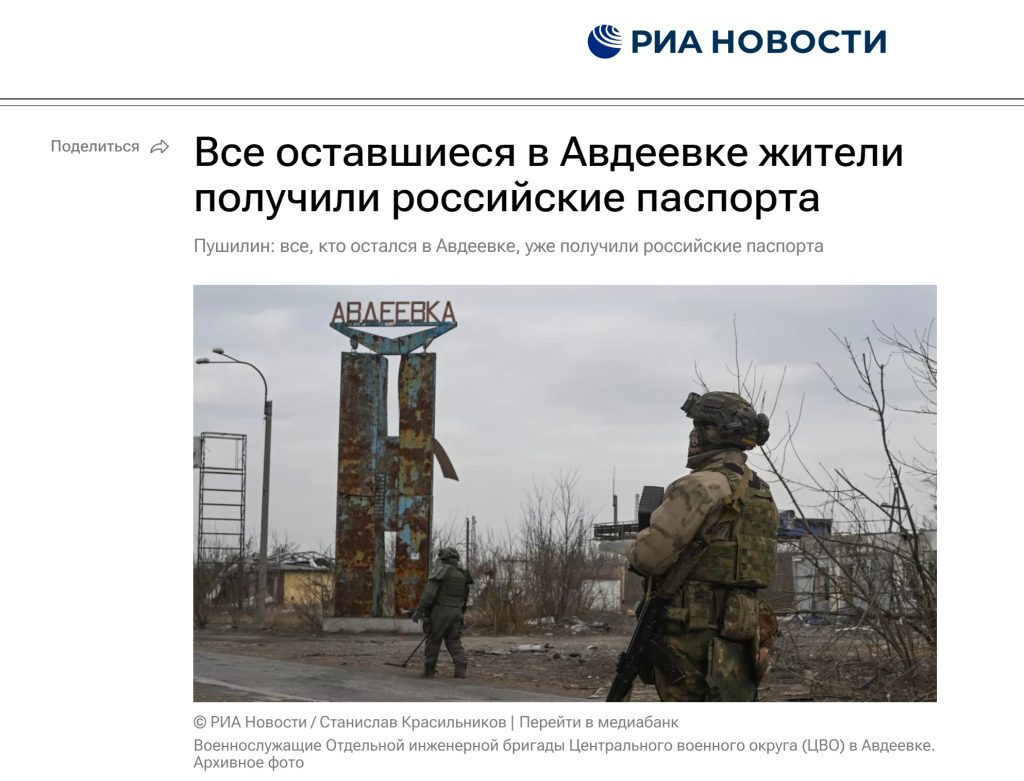
One can find a somewhat odd clip showing the first deputy head of the Russian presidential administration, former Prime Minister Sergei Kiriyenko, visiting the city of Avdyivka, which was occupied by the Russian army in February. The visit itself apparently took place in June, and its purpose might have been to demonstrate that significant changes are happening in the war-torn settlement.
In an archival photo published with the corresponding report by RIA Novosti, one can see that large rusty metal structures have already been adorned with Russian-language city name signs. This, at least, is reality – not fiction, which we will touch on a bit later. According to the same agency, Russian passports are being issued to the remaining residents of the city, and various services are being initiated.
No ice cream sold in Avdyivka
A video clip circulating on Telegram unintentionally provides humor by showcasing a specific situation where Sergei Kiriyenko reaches a portable kiosk on a street corner selling food and various knick-knacks. Visible are sausages, butter, etc. This is presumably meant to indicate that normal life is beginning to resume under Russian rule in a war-torn city, although there are still shortages in supplies. Kiriyenko asks the kiosk operator what people are buying. It turns out that there is demand for fresh fruits and vegetables, but unfortunately, they are not available. People are buying sausages and dairy products.
“How often will you be here?” Kiriyenko asks further and gets the reply, “As ordered.”
“But do you have ice cream?”
“Unfortunately, no.”
“It needs to be brought in! You have a fridge, after all.”

Such care for the long-suffering common people by the First Deputy Chief of the Russian Presidential Administration in a city that was completely destroyed by Russian forces in the war, and by 2023 had only a few percent of its pre-war population left. Before Russia’s full-scale invasion, over 30,000 people lived in Avdyivka near Donetsk.
This type of concern for ordinary consumers is very common in Russian propaganda. Last year, patrols from the ruling party United Russia continuously checked whether food prices in stores across the occupied territories of Ukraine were “fair.” If the commission found the prices to be “unfairly” high, shop owners were chastised on social media and threatened with administrative measures.
Work is already underway for new conquests.
Avdyivka is also the central character in a more polished Russian propaganda video, where the main narrative again revolves around signs. This clip, titled “Work, brothers!”, spread on Telegram channels at the end of June and can also be seen on YouTube: https://youtu.be/n7Q4b-yv_30.
The protagonists are two road workers in reflective vests who remove a bullet-riddled, Ukrainian-language Авдіївка sign from a metal post on the side of the road and replace it with a new, clean, Russian-language Авдеевка sign. The old sign is thrown into the trunk of a car, where a pile of similarly worn and ugly metal pieces can already be seen.
“Is there still a lot to do?” asks the younger worker.
“A lot. But the job must be finished!” replies the older one. The camera then focuses on shelves filled with new, shiny Russian-language signs waiting to be used: Chasov Yar (Chassiv Yar, where battles between advancing Russians and Ukrainian defenders are currently taking place), Kherson, and Zaporozhye (the Ukrainian Zaporizhzhia).
A column of armored vehicles with Russian flags drives by, Russian fighter jets fly overhead… almost like a parade. Meanwhile, the workers pour themselves a drink from a thermos – it’s unclear whether it’s coffee or champagne to celebrate the anticipated victories.
This clip is clearly designed and produced by professionals. While many might see it on social media, an analysis by the think tank Atlantic Council on Telegram as a medium for spreading Russian propaganda indicates that Kremlin-loyal media channels referred to Telegram links 6,026 times in 2021, and by 2023, that number had risen to 33,300 – a 481 percent increase. Many Russians consume material published on Telegram without any intermediaries, making it one of the main channels for news dissemination.
Some Telling Clips in the Big Propaganda Heap
A large portion of the video clips posted on Telegram by pro-Russian bloggers and others primarily interests hardcore war enthusiasts or those who genuinely try to analyze these videos to understand what is happening on the front lines.
Drone videos are very common, showing some landscape or a tiny war machine blowing up on film. Neither side shies away from showing the mutilated corpses of enemy soldiers. There are restricted-access Russian channels that promise to show “real” and uncensored warfare. Many clips detail various military equipment or showcase destroyed enemy vehicles, rocket fragments, etc. This content is not for a broad audience, but the sheer volume still has some impact on anyone who happens to browse through it.
Even among such a vast array of videos, some clips stand out, speaking more than the filmmaker perhaps intended. For example, a clip where a Russian Orthodox priest blesses soldiers presumably heading into battle – showing holy scriptures, weapons, and motorcycles.

New Defense Minister Andrei Beloussov in Vladivostok: if you don’t complete the new military unit on time, you will face criminal liability! Source: Telegram, screenshot.
Telegram users know that on the front lines, Russian units use motorcycles, golf carts, and other light vehicles to quickly reach Ukrainian trenches, where they try to push back the defenders. However, in reality, many participants in such attacks are sent to certain death, as they are met with machine gun fire or targeted by attack drones. This makes clips showing soldiers making the sign of the cross rather ominous, with their facial expressions not promising anything good.
Another example is a clearly produced clip by the Russian Ministry of Defense, where the new Defense Minister Andrei Beloussov inspects a military unit in Vladivostok. Construction is underway, presumably building living quarters for soldiers, and Beloussov admonishes an official responsible for the construction: “Just try not to complete it on time, and you will face criminal liability!”
This clip speaks to two things simultaneously: firstly, it demonstrates that the new defense minister is a strict boss who does not joke around. Secondly, it shows that he prioritizes ensuring proper living conditions for Russian soldiers. However, for this to matter, they need to survive on the Ukrainian front.












































