In early August, Propastop exposed a disinformation attack targeting Estonia. It involved a fabricated report claiming that Portuguese fighter jets had been damaged at Ämari Air Base. A more detailed study by DFRLab, published in September, confirms that this was not an isolated piece of disinformation, but part of a broader Russian influence operation known as Storm-1516, which has been linked to Russia’s military intelligence agency, the GRU.
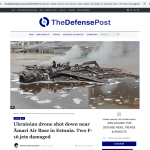
On 6 August, a claim began circulating on the social media platform X that a Ukrainian drone had been shot down in Estonian airspace and that its debris had damaged two Portuguese Air Force F-16 fighter jets stationed at Ämari. The alleged damage was said to amount to €120 million. No such incident actually took place.
In an analysis published on 12 August, Propastop reported that a copy of the international defence news outlet The Defense Post had been created to spread the false report. The original outlet operates at thedefensepost.com, while the fake site was hosted at thedefensepost.eu. The fraudulent domain was registered on 3 August, just three days before the false report began circulating. Propastopi tehniline analüüs näitas, kui põhjalikult oli võltsing ette valmistatud, aga ka seda, kui lohakalt oli see teostatud. Libauudise aluseks oli võetud originaalväljaande artikkel, mille tekst asendati väljamõeldud looga. Veebilehe lähtekoodi sisse jäid aga alles esialgne artikkel, selle autor, jagamislinkide tekstid ja isegi originaalportaali Google Analyticsi tunnus. Libalehe lähtekoodis mainiti originaaldomeeni 45 korral, võltsdomeeni vaid viiel korral.
The false report was bolstered by an AI-manipulated video that used footage from the Estonian Defence Forces and added a clip showing burning aircraft wreckage.
From Propastop’s discovery to an international network
Propastop found that the first known post was published by Raphael Machado on X in Portuguese at 9:51 a.m. on 6 August. Posts by Lucas Leiroz and other accounts followed. Most of those spreading the claim were pro-Russian accounts linked to Portugal or operating in Portuguese.
The initial analysis already suggested that the attack aimed to damage NATO’s reputation, undermine support for Ukraine and influence public opinion in Portugal.
A study published on 17 September by the Atlantic Council’s Digital Forensic Research Lab (DFRLab) added an important dimension to Propastop’s discovery: a link to the Storm-1516 influence operation.
According to DFRLab, Storm-1516 is a Russia-linked disinformation network whose activities have been publicly attributed to Russia’s military intelligence agency, the GRU. Technical and organisational links have also been found to earlier operations associated with Yevgeny Prigozhin.
DFRLab’s study added that Raphael Machado, who first spread the Ämari false report, leads the Brazilian organisation Nova Resistência. France’s service for monitoring foreign influence, VIGINUM, had previously identified Nova Resistência as an amplifier of Storm-1516 campaigns.
Lucas Leiroz is also linked to Nova Resistência and has worked for pro-Kremlin media outlets. Both men are part of a broader network of accounts and influencers used to spread Russian messaging in different countries.
By connecting the specific fake report identified by Propastop with DFRLab’s earlier research, it became possible to show that those who spread the Ämari disinformation were linked to a known international influence network.
 Four attacks targeting the Baltic states

Between 30 July and 17 August, DFRLab identified four disinformation campaigns targeting the Baltic states. Besides the Ämari incident, they included fabricated allegations linking the presidents of Estonia and Lithuania to Jeffrey Epstein, a false report about NATO soldiers being killed during an exercise in Latvia, and a misleading claim that few people called up for military service in Latvia had reported for duty.
The campaigns shared several features: they misused the visual identities of well-known media outlets, circulated fabricated videos and relied on social media accounts previously linked to Storm-1516 activity.
Across seven online platforms, DFRLab identified a total of 275 reports or posts connected to the campaigns. The study found that several accounts amplified more than one false report.Propastopi roll rahvusvahelises vastutegevuses
An overview published in October by disinformation research company Refute highlighted Propastop’s work as an example of the Baltic states’ ability to quickly detect and expose influence operations.
Refute noted that Russia-linked campaigns are increasingly using cloned news websites, AI-generated videos and false claims spread in multiple languages. These methods can be reused repeatedly at relatively low cost.
The Ämari case shows why it is important to examine not only the content of a false report, but also its technical structure, the timing of its spread and the first accounts to share it.
Propastop’s August analysis identified the forgery and documented how it spread. DFRLab’s September study placed the case in the context of an international influence network. Refute’s October overview highlighted the importance of local investigations to wider resilience.
Loe ka Propastopis avaldatud DFRLabi tõlkelugusid:
The Harmony party’s unexpected moves in Latvia
Solidarity among defenders of the Russian language
Information security basics for Russian soldiers taking selfies