Vladivostok lies in Primorsky Krai, between China’s Heilongjiang Province and the Sea of Japan, beyond Lake Baikal and the Stanovoy Range, in a region that belonged to the Chinese state for centuries. The city is home to an important commercial port and a base for the Russian Pacific Fleet. It looks like many other Siberian cities, with grey Khrushchev-era apartment blocks and a few onion domes breaking up the monotony.
Yet people with Asian features are becoming increasingly common on its streets, along with grumbling that Vladivostok should really belong to China. The city is still known by its Chinese name, Haishenwei, and those who follow the issue closely find it plainly offensive that Vladivostok means “ruler of the East” in Russian. The city attracts large numbers of Chinese tourists, migrant workers, traders, and investors. Many still regard Vladivostok and its surroundings as Chinese territory.
The previous two posts showed that the image of Russia and Russians on Chinese social media is mixed. In the posts that follow, we will look at grievances related to the border. Of the territories lost, the cession of Far Eastern lands, especially the city of Vladivostok, seems to cause the deepest emotional pain. One likely reason is that these areas lie closest to China’s political heartland and were incorporated into the Russian state relatively recently. But this is not simply a story about lost territory. It is also about Chinese geopolitical cosmology, the worldview that drives these arguments.
Confucian Cosmology
Before China was forced to join the Western-led international community, its political worldview was entirely different. China was seen as the only truly civilized political entity, with unquestioned influence over its immediate neighbourhood. According to the concept of tianxia (“all under heaven”), China stood at the centre of the world, its influence spreading outwards from a cultural core in concentric circles. The concepts of the nation-state and sovereignty were unfamiliar to the Chinese; their understanding of the state, collective identity and borders was rooted in Confucian cosmology. All diplomatic envoys were expected to pay homage to the Chinese emperor as the Son of Heaven (tianzi) and the sole representative of Heaven on earth.
China’s current leaders are known to have borrowed elements of Confucian cosmology, even though the Communist regime is not Confucian and the imperial-era worldview is not part of the country’s official doctrine. Yet Confucianism’s influence is more than symbolic. Although China is now one nation-state among many, rather than the cultural empire it once was, the idea of China as the centre of the world has endured. This belief gives Chinese nationalism an aura of cultural superiority. The Chinese still use the name Zhongguo (“Middle Kingdom”) for their country, even though the official name of the People’s Republic of China, Zhonghua Renmin Gongheguo, uses the term Zhonghua. In the view of the renowned China scholar Ross Terrill, this helps explain the supposedly imperialist character of Chinese nationalism.
“The Lost City”
Vladivostok lies more than 5,000 kilometres from Moscow as the crow flies, and as far as 9,500 kilometres by road. These distances matter because, according to the tianxia worldview, areas close to China’s capital should fall within its sphere of influence. Tiananmen Square, the political centre of China, is only 1,000 kilometres to the southwest. (As the crow flies, Russia’s nearest border crossing is near the Hailar River bridge in Inner Mongolia, about 950 kilometres from Beijing.)
Territorial claims are generally approached cautiously. The author of one post praises the Chinese Communist Party for “seeing the big picture” and “maintaining a stable border” with Russia, rather than giving in to emotional appeals and putting international stability at risk. At the same time, the article’s tone clearly expresses regret over the loss of Vladivostok, described as one of China’s greatest “historical losses”. The author acknowledges that China’s room for maneuver is constrained by international law, which prevents Beijing from reclaiming territories it considers historically its own. Unlike Hong Kong and other territories lost to colonial powers, Vladivostok and the other lands were not leased to Russia; they were ceded permanently.
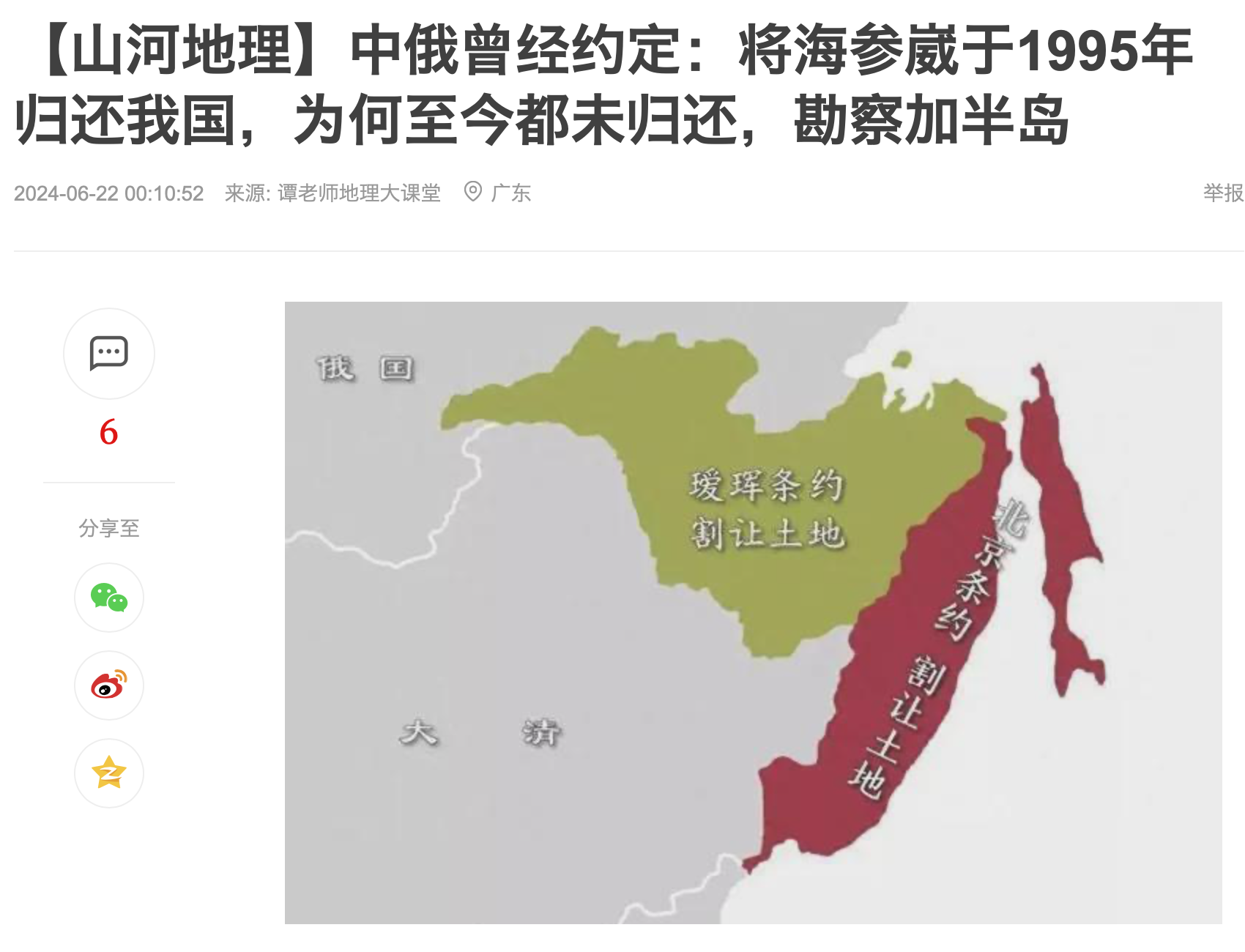
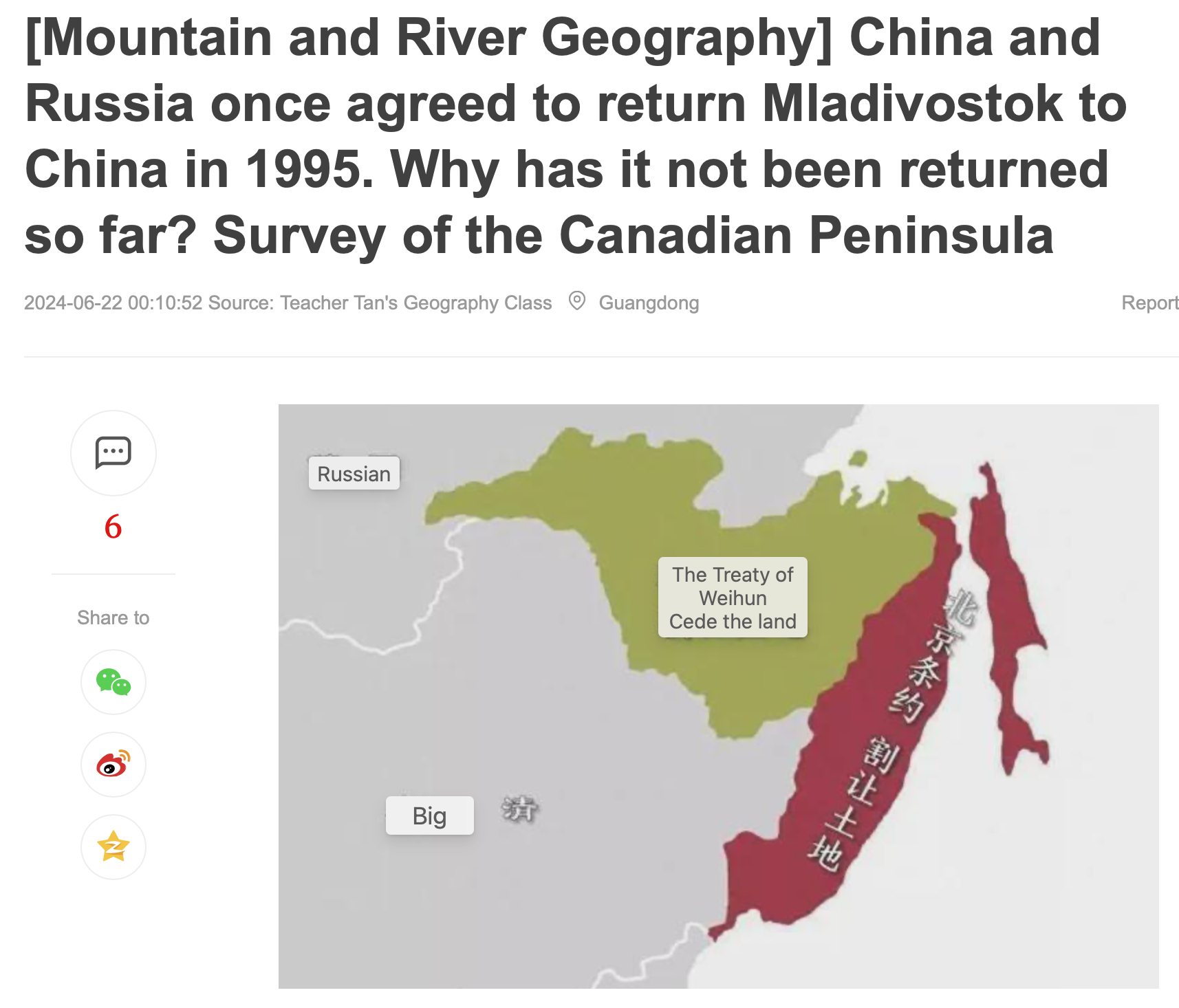
Vladivostok’s status as part of Russia poses a moral dilemma for the Chinese: they want to recognise Russia as a geopolitical partner while also declaring Vladivostok a historic part of China. The author of one article, for example, acknowledges that Russia and China “are making great efforts to continuously develop relations between the two countries”, while also describing Vladivostok as a “lost city”. This contradiction is summed up most clearly in the appeal: “Although Vladivostok currently belongs to Russia, we should remember history, cherish the present and work hard for the great rejuvenation of the Chinese nation.” Even the most pro-Russian accounts, then, cannot avoid the fact that Vladivostok symbolises the injustice of colonialism.
Despite this contradiction, the position fits neatly with Beijing’s official discourse. Fuelled by nationalist sentiment, it calls for the reunification of the “motherland” while treating Russia as a partner in the struggle against US hegemony. This tension can be explained through the logic of “united front work”, discussed in more detail in the previous post. In short, historical grievances involving Russia can currently be treated as “non-antagonistic” and set aside temporarily, but they are expected to become pressing again in time. Such contradictory views may already be weakening Russia–China relations, creating confusion and distrust towards both the Russian and Chinese governments.
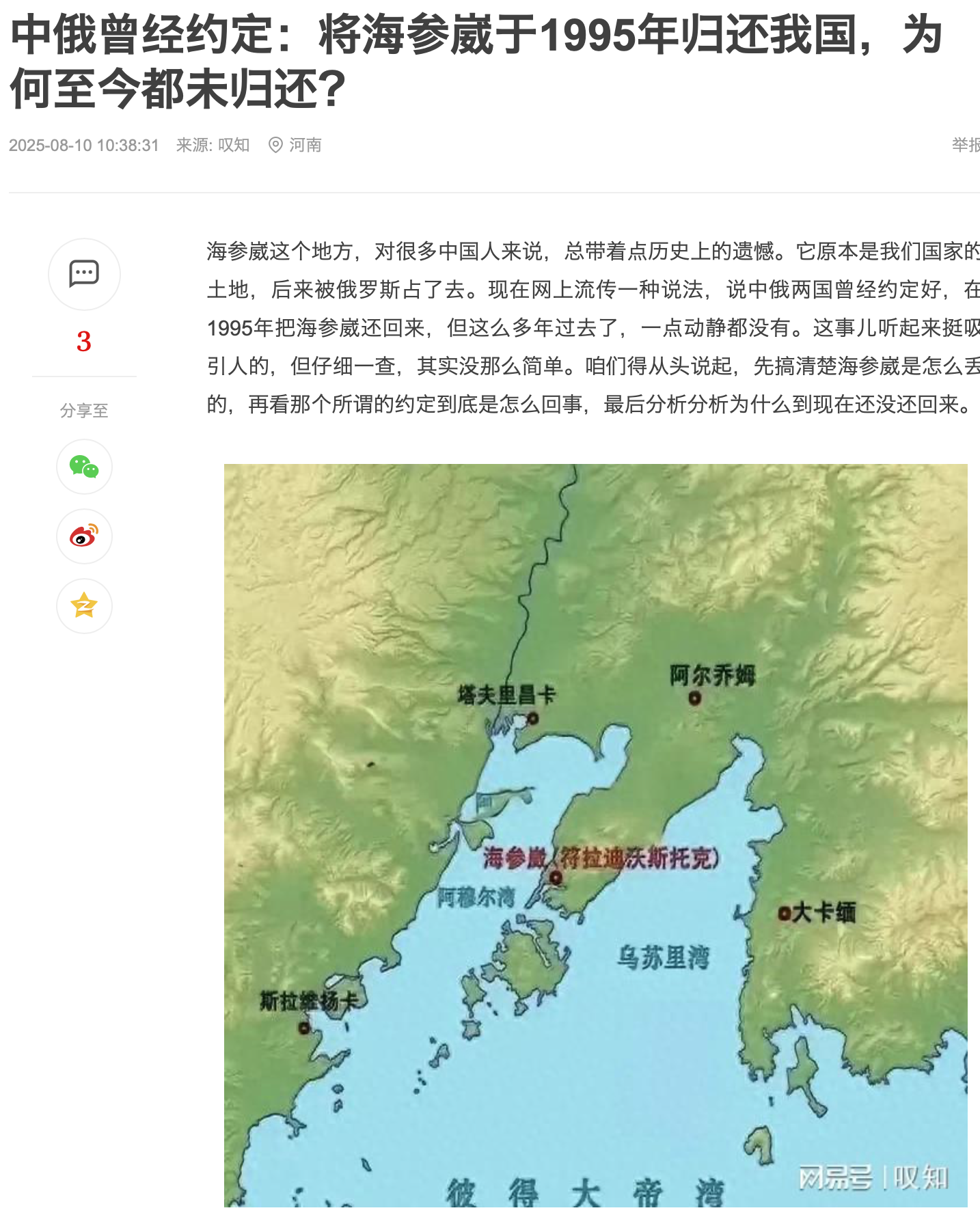
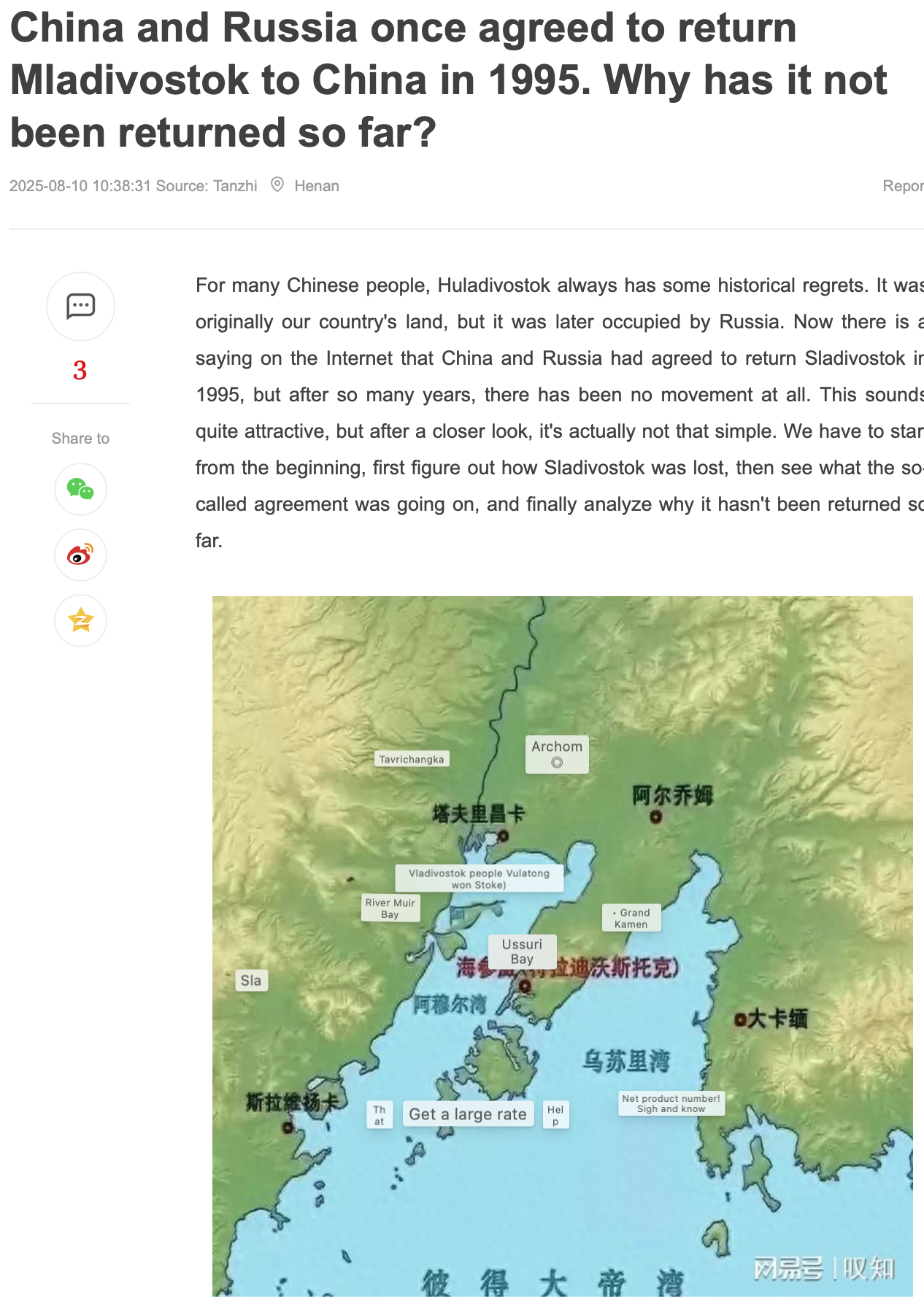
Yet Chinese internet users have no doubt that Vladivostok is historically a Chinese city. Chinese social media is full of ultranationalist views calling for the immediate return of all lost territories. “This place has been closely connected to China for a very long time,” one author writes, claiming that Chinese people lived there as far back as the Tang dynasty.
Another article states: “After Tsarist Russia occupied Haishenwei, it was renamed Vladivostok, which literally means ‘conquering the East’. That drove a nail into our hearts.” Some authors portray the city as almost an unnatural part of Russia: “Think of the 9,000-kilometre distance from Moscow to Vladivostok. It takes seven days to cover it by train. [The Russian state] resembles a stretched-out rope, pulled tighter and tighter.”
A Return to Confucian Cosmology?
These descriptions resonate with China’s political cosmology and suggest that Vladivostok should, by its very nature, belong to China, the “Middle Kingdom”. As noted above, the concept of tianxia places Beijing at the centre of the world and assumes that China’s influence spreads outwards from its cultural core towards the periphery. This raises a question: why are territories so close to China’s heartland governed from distant Moscow? The answer seems obvious to many Chinese social media users: they shouldn’t be. Under the logic of tianxia, the territories of Eastern Siberia, which are geographically relatively close to Beijing, belong to China. The fact that these lands once belonged to the Qing Empire only adds fuel to the fire.
Russia’s elite, by contrast, still sees Moscow, not Beijing, as the geostrategic centre of Eurasia and is unwilling to give up the territories of Eastern Siberia. Both sides are sincerely convinced of their own cultural superiority and their vision of how the world should be ordered.
When considering countermeasures against cognitive warfare, the idea of Vladivostok as a “lost city” is perhaps one of the most fertile narratives for driving a wedge between Russia and China. It may also offer one of the first geographic locations from which to begin.
This article is based on the University of Tartu Asia Centre report “Chinese Netizens’ Perceptions of the Sino-Russian Border”.
Cover photo: Flickr / Marco Fieber, CC BY-NC-ND 2.0
Images in the article: screenshots of articles