Imagine you wake up in the morning and open your phone. Your news feed is full of stories claiming that the Estonian government is secretly planning to raise pensions only for selected groups. Friends are sharing the post with angry comments. Someone asks if it’s true. The story feels believable, because it cites an unknown but official-sounding website as its source.
A little later, it turns out the entire story was made up. But the damage is already done. Distrust has been planted, and the question lingers in the air.
It is in moments like these that the concept of FIMI becomes visible.
Where does this concept come from?
FIMI, or foreign information manipulation and interference, is a term introduced by the European External Action Service to describe interference by foreign states in the information space. In the European Union’s understanding, it refers to activity that is intentional, manipulative, and coordinated, with the potential to influence political processes and social cohesion. (EEAS)
The term itself was created to specifically describe foreign interference in the information environment and to distinguish it from domestic information manipulation. At the core of FIMI is not a single falsehood, but activity that is targeted and coordinated. (Debunk.org)
This means that FIMI is not an event. It is a process that develops over time.
What makes FIMI different?
Disinformation and propaganda haven’t gone anywhere. What has changed is how they are used.
Where it was once often enough to fact-check a single claim, FIMI requires looking at the bigger picture. Does the same message appear across multiple channels at the same time? Is it amplified by different sources? Does it tap into existing fears or tensions?
In FIMI frameworks, the focus is on patterns of behaviour. These activities may formally stay within legal boundaries, yet still be harmful because they influence democratic processes and social cohesion. (Debunk.org)
If a single falsehood can be an accident, a coordinated spread is not.
What does FIMI look like in practice?
In real life, FIMI doesn’t appear as one big, obvious operation. It shows up in a more diffuse way — through repetition and patterns.
Analyses by the European Union point out that influence activity happens simultaneously on multiple levels. State media, social media, diplomatic networks, and local intermediaries don’t operate separately. They reinforce each other, amplifying the same message across different channels. (EEAS)
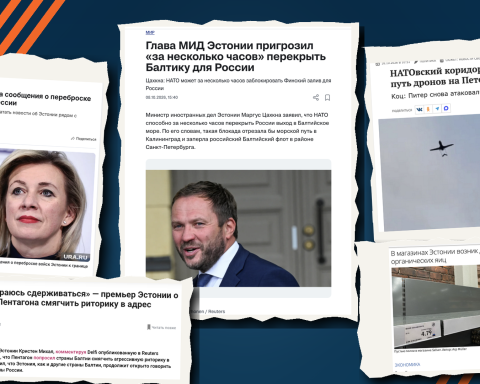
A clear example is Russia’s activity in the context of the war in Ukraine. EUvsDisinfo has documented numerous cases where narratives about NATO’s alleged aggressiveness and the supposed failure of Ukrainian statehood were spread. The same logic is familiar in the Estonian context.
This pattern is also described in recent annual reports by the Estonian Foreign Intelligence Service, which stress that Russia’s information influence activities are systematic, long-term, and aimed at dividing Western societies and undermining trust.
A similar approach has been observed in election contexts. After the 2016 U.S. presidential election, the United States Senate Intelligence Committee report described how Russia used social media and other channels to deepen societal divisions. Special Counsel Robert Mueller reached similar conclusions, highlighting coordinated efforts to influence public opinion.
Why is it called interference?
The second part of FIMI is interference. This means the goal is not just to spread information, but to achieve a real-world effect.
Often, it’s not even necessary for people to fully believe a specific falsehood. It’s enough to create doubt and uncertainty. When trust declines, it becomes harder to make collective decisions and to sustain meaningful public debate.
This is exactly what is emphasised in the European Union’s approach, where FIMI can influence political processes and social cohesion even when no single action directly breaks the law. (EEAS)
Why does this matter now?
Recent analyses show that these kinds of influence activities are becoming more sophisticated. Digital platforms, targeted messaging, and new technologies — including artificial intelligence — are being used to shape public perception and erode trust in institutions. (Trilateral Research)
This means that a single story is almost never the whole story. The same narrative can travel across languages, platforms, and formats, while following the same underlying logic.
In summary
FIMI is not just a new label for an old phenomenon. It’s an attempt to describe influence activity as it actually works today.
When we talk about disinformation, the focus is often on whether something is true or false. With FIMI, the lens is wider. How does the information move? Who amplifies it? What kind of overall effect does it create?
A single falsehood can be a mistake. A pattern is not.