February brought more attention than usual to the Estonian information space. The Foreign Intelligence Service’s annual report made it into hundreds of foreign media stories, NATO exercises brought journalists from across Europe, and several statements by Estonian politicians triggered reactions in Moscow as well. At the same time, disinformation spreading in pro-Kremlin spaces grew noticeably, and the use of artificial intelligence for producing propaganda content became more frequent.
The Foreign Intelligence Service’s annual report put Estonia on the world media map.

February’s biggest media event was the publication of the Foreign Intelligence Service’s annual report. In connection with it, nearly four hundred foreign coverage pieces appeared. The number of coverage items surpassed the previous record from 2024 by nearly two hundred and was several dozen times greater than the result from the same month the previous year.
The report’s conclusions on Russia’s military plans were widely cited in international media. The most referenced piece was an Associated Press article — “Russia can’t attack NATO this year but plans to boost its own forces, an intelligence chief says” — which summarized the Estonian intelligence assessment that Russia is not ready to start a war against NATO in the near future, but is steadily building up its military capability.
The report’s impact was further amplified by the Swedish military intelligence annual report published a few days later, which reached similar conclusions.
Munich: relief and uncomfortable questions

Around a hundred articles touching on Estonia appeared in connection with the Munich Security Conference. AFP, Deutsche Welle and CNBC cited Estonia’s prime, defence and foreign ministers, primarily in relation to comments on the US Secretary of State’s speech. The overriding tone was one of relief — the US and Europe are still allies. At the same time, it was emphasised that it is Russia, not Ukraine, that must be pressured.
Several articles raised the question of the credibility of US commitment to collective defence. BBC security correspondent Frank Gardner used the phrase “The Narva test” in this context. He asked whether NATO Article 5 would hold in a situation where Russia attacked Narva under the pretext of protecting the Russian-speaking population. (BBC)
Tsahkna’s statements: the West references, the Kremlin reacts
Foreign Minister Margus Tsahkna’s two statements attracted remarkable international attention in February.

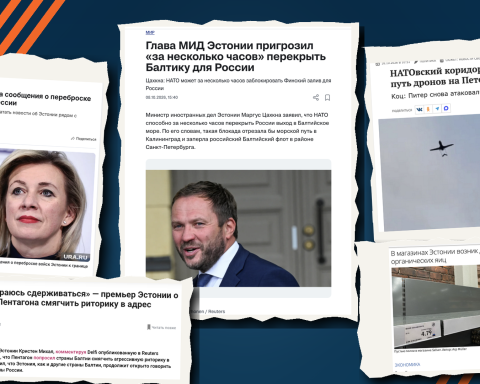
In an interview given to the British newspaper The Telegraph, Tsahkna said that in the event of a Russian attack, NATO’s response would not be limited to defending its own territory alone. The interview provoked a sharp reaction in Moscow.
Tsahkna’s interview on the ERR program “Esimene stuudio” also caused a stir. There he said that Estonia would, if necessary, be prepared to consider the deployment of NATO nuclear weapons on its territory. The statement drew comments from both Kremlin spokesman Dmitri Peskov and Vladimir Putin.
International media often focused primarily on Russia’s reactions, which cast Estonian statements in a different news frame.
“We are f***d”: the WSJ article travelled East and West
A Wall Street Journal article generated a huge response, examining war games conducted during NATO exercises and the impact of drones on the modern battlefield. (“NATO Has Seen the Future and Is Unprepared”, Wall Street Journal)
Last year’s “Siil” exercises had apparently shown in shocking fashion how vulnerable alliance units are on a drone-dominated battlefield: ten Ukrainians had allegedly “destroyed” two NATO battalions in a single day, and an Estonian lieutenant colonel had summed up the situation with the words “We are f***d.” The story spread rapidly in both Western media and Russia’s propaganda space.
“Talvelaager” (Winter camp) and stories from Narva
The NATO exercise “Talvelaager” brought dozens of foreign journalists to Estonia. Their reports covered allied forces training near the Russian border, winter conditions and Estonia’s defence readiness.

At the same time, stories also appeared about Narva and the Russian-speaking population. Several AFP reports covered the transition to Estonian-language instruction and claimed that some pupils are experiencing difficulties with it. These stories quickly fed into narratives circulating in Russia’s propaganda space. (France24 (1), France24 (2))
Disinformation from the East grew markedly
In February, disinformation coming from the East grew by almost 50 percent compared to January, also exceeding the average level for 2025.

One of the most widely covered topics was an interview given by the Estonian President and Latvian Prime Minister to Euronews, in which they called for direct talks between the European Union and Russia to continue. In pro-Kremlin information spaces this was interpreted in several ways. Claims were made that Estonia had grown disillusioned with Western policy, or that Estonia’s leadership was divided among itself.
The second major narrative concerned Estonia’s decision to detain a vessel bound from Ecuador to St Petersburg. In Russian media the incident was portrayed as piracy by the Baltic states, with claims that Estonia was acting on British instructions.
The third topic was a statistical news item reporting that 17 more students from the Baltic states had gone to study in Russia compared to the previous year. This minor change was presented in propaganda channels as evidence that Russia is not internationally isolated.
Artificial intelligence as a disinformation tool
February brought several examples of how artificial intelligence is being used to produce and spread false information.

Russian state television broadcast fabricated front pages of French newspapers criticising Ukrainian President Volodymyr Zelensky. It later emerged that these were forgeries created by a bot network. (Insider)
During the Milan–Cortina Winter Olympics, a series of fabricated Euronews videos spread across social media. These disseminated false claims about Ukrainian athletes and refugees. (Euronews)
OpenAI announced at the same time that it had blocked a network of accounts linked to Rybar — a pro-Russian Telegram channel — which had been used to generate propaganda texts with the help of ChatGPT. (Insider)
A study by Ihor Samokhodskyi, a summary of which was published on the Propastop website, showed that when questions are posed in Russian, AI repeats propagandistic narratives with very high probability.
In summary
February once again showed how closely international journalism and influence operations are intertwined. Estonia reached world media through intelligence reports, NATO exercises and politicians’ statements alike. At the same time, disinformation spreading in pro-Kremlin information spaces grew noticeably, and artificial intelligence is being used increasingly often to disseminate it.