On 11 December 2025, Harju County Court found Aivo Peterson guilty of treason and sentenced him to 14 years in prison. His co-defendant Dmitri Rootsi received 11 years, and Andrei Andronov (a Russian citizen) also received 11 years. The verdict was reported as appealable.
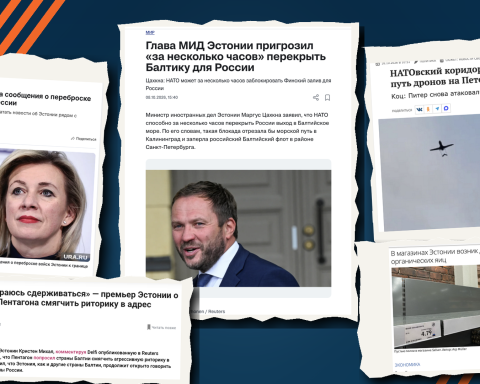
In Russia’s information space, the case was not ignored. But the reaction was lopsided: plenty of emotional coverage in aligned outlets and a noticeably weaker “official” push than we saw in Oleg Bessedin’s detention in November 2025, when Russia’s Foreign Ministry spokesperson Maria Zakharova issued a formal response to a media question.
“Estonian politician Peterson ended up in prison for trying to understand Donbas.”
Some Russian outlets went with a minimal, low-effort rewrite: “Estonian court sentenced Peterson, source: ERR.” Gazeta.ru is a clean example of that format. It reports the sentence and leans on attribution, rather than building its own argument.

VZGLYAD did the opposite: it centered the story on one emotionally loaded episode, Peterson’s visit to Donetsk and his later media appearances. That framing is the core of how the outlet has treated the case for years, including earlier pieces that presented the story as punishment for wanting “good relations with Russia” and even discussed the idea of a potential life sentence.

“Political persecution of a magnet for votes”
Regnum frames Aivo Peterson’s verdict through a simple, emotional storyline: he was “punished for a trip to Donbas/Donetsk,” not convicted for a broader treason case. Early on it adds a political plotline, claiming Estonia’s “elites” saw him as a dangerous rival and tried to “switch him off,” supported by an “ordinary man” biography and a strong angle about allegedly humiliated Russian-speaking voters, calling Estonia’s system “totalitarian/Stalinist” and portraying the sentence as intimidation.
Svobodnaya Pressa frames the Peterson verdict as a moral outrage, not a legal decision. The headline and subhead do the heavy lifting: Estonia’s justice system is mocked with scare quotes (“‘independent’ court”), while the case is reduced to a “humanitarian” Donetsk trip.

“An ‘independent’ court saw treason in politicians’ humanitarian trip to Donetsk.” By “the Swiss,” they actually mean Justice pour Tous Internationale (JPTi), a group set up in 2022 and co-created by Sharof Azizov, a known Kremlin sympathiser with UN background. Screenshot: Svobodnaya Pressa.ru
The article then amplifies the message with familiar “expert” voices like Mezhevich and Trukhachev, asserting that there were “no facts” and portraying the sentence as political repression. It finishes by nudging the reader from anger toward action, floating pressure tactics like border and customs restrictions and prisoner-swap logic.
Tribuna.ee: verdict as a pre-framed bundle
On December 12, 2025, Tribuna.ee presented Aivo Peterson’s verdict less as a news event and more as an interpretation kit. The most prominent items were three “НАРОДНЫЙ ТРИБУН” opinion pieces that deliver a persecution storyline in three steps: “prison for intentions” (Kimmer), “the case is a farce” (Maslyakov), and “a lesson for dissenters” (Barinov). Together they shift the topic from evidence and legal reasoning to fear, identity, and distrust of institutions.

Only after that does Tribuna.ee include a more straightforward “CRIME” item quoting the prosecutor’s office saying the charges were proven. In this lineup, it feels like a small nod to balance, while the opinion pieces carry the main emotional message.
The pro-Kremlin Facebook group “Russkoyazychnaya Estonia” published three posts about the verdict. Two were reposts from Tribuna.ee: Barinov’s opinion piece and a more neutral, straight-news update on the court decision. A third post was another neutral news update on the ruling.
The emoji reactions and comment threads point to a strongly hostile response overall, and Peterson-related posts drew noticeably more engagement than many other posts in the group.


With Peterson, Propastop did not see a comparable, high-profile, standalone reaction from Russia’s top spokespersons (the Kremlin press service or a dedicated MFA comment) in the same way the Besedin case produced. After 12 December, the topic largely disappeared from the Russian news agenda and pro-Russian channels in Estonia, suggesting there was no sustained official push or follow-up messaging campaign.