Today, we’re continuing our series of overviews on influential Russian-speaking YouTubers living in Estonia—creators who shape the local information space and influence people’s emotional attitudes. In the previous parts (1, 2, 3), we covered a wide range of YouTube channels. Today, we’ll introduce some new names that, each in their own way, add to the richness of Estonia’s Russian-language media landscape.
Georg Rudi
One of the most notable YouTubers on our scene is Georg Rudi, who started out as an influencer on TikTok but later successfully moved his audience over to YouTube. He posts videos roughly once a month and attracts up to a couple of hundred thousand views.

His channel mostly delivers sharp criticism of the authorities and the state. Rudi often uses emotional language and contrasts “ordinary people” with the elite. This approach helps his posts go viral and reflects a propaganda strategy aimed at undermining trust in those in power.
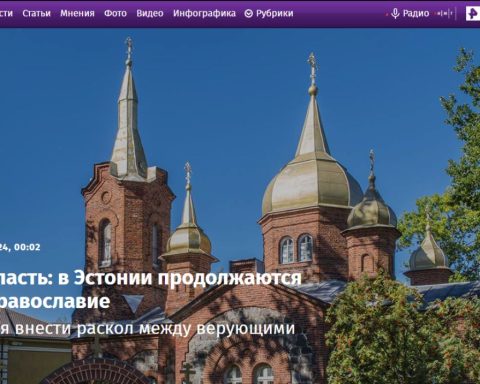
A video published on February 17 this year, which has gained 18,000 views, was titled “Shame on the Estonian government!” It described an incident in which nuns from the Pühtitsa Convent arrived unannounced in front of Toompea Castle to deliver a petition. The video disparages the Estonian parliament and government, playing on the emotions of religious viewers.
Quote from the video:
“What kind of morally bankrupt people sit in the Riigikogu? /…/ And how else am I supposed to describe people who mock women? /…/ Estonia wants to pass a law that would force absolutely all Orthodox churches to leave the jurisdiction of the Moscow Patriarchate. As if that’s easy to do!? And if such a law really does pass, then the Pühtitsa Convent will be shut down. Abbess Filareta has been trying for over a month to appeal to reason and explain to the blockheaded politicians that this solution won’t work. /…/ But of course, in Estonia no one listens to the voice of reason, and they’re ramming this law through.”
(In reality, President Alar Karis has twice refused to promulgate the law passed by the Riigikogu—editor’s note.)
Mihhail Stalnuhhin
The YouTube channel of Mihhail Stalnuhhin, a former member of the Riigikogu and now a member of the Narva City Council, focuses on politics and social issues in both Estonia and Narva. The channel’s format is an interview with Stalnuhhin, where the man asking the questions remains off-camera, and the viewer sees and hears only Stalnuhhin. The range of topics is exceptionally broad—covering both domestic and foreign policy, local elections, and Western relations with Russia.

Stalnuhhin devotes particular attention to criticizing the Estonian government and, personally, the European Union’s High Representative for Foreign Affairs and Security Policy, Kaja Kallas. He uploads videos almost daily, consistently drawing several thousand views—sometimes over 10,000. On screen, Stalnuhhin seems confident and uses colorful language, presenting himself to his Russian-speaking audience as an independent commentator.
Some episodes feature themes that align with Russian narratives—particularly when discussing the “discrimination of Russian speakers” or “crackdowns on dissent.” These topics don’t dominate the content, but they do create a backdrop that fosters a sense of conflict between “the authorities” and “the people.”
Quote from a video:
“Let’s present the infringement of non-Estonians’ rights as patriotism. Let’s cut off their oxygen in churches, in education, cut off the oxygen to the monuments of their grandfathers and great-grandfathers—because that’s patriotic, and people should like it,” Stalnuhhin said ironically.
With an average daily audience of around 10,000 viewers, the channel is a highly effective communication tool in Narva. There’s no doubt YouTube played a significant role in the success of Stalnuhhin’s list in the recent municipal elections.
“Living Voices” (Vadim Alyunin)
The channel “Living Voices”, launched about a year ago, stands out from other blogs with its calm and thoughtful approach. Its host, Vadim Alyunin, engages in unhurried, respectful, and detail-oriented conversations with guests from the worlds of art, science, business, sports, and politics.
New videos are released about once or twice a month and are notable for their high-quality filming and editing. The project also has a presence on TikTok, Instagram, and Facebook, where clips from interviews and episode announcements are shared.
Among the guests have been many well-known figures from Estonia’s Russian-speaking community, such as actor Aleksandr Ivashkevich, TV host Andrei Titov, journalist Elena Solomina, political analyst Yevgeny Krishtafovich, and others.
Lately, Aleksandr Chaplygin has become a frequent guest, answering viewers’ questions—including those about politics. His responses often come across as quite radical.
Example from a video:
Alyunin: “The border with the Russian Federation (Narva–Ivangorod): is it a lack of resources that keeps it from being open 24/7, or a lack of will?”
Chaplygin: “Of course, there’s no desire to provide people with humane conditions for crossing the border.”

Alyunin himself avoids taking sides and does not promote Kremlin narratives, although some guests occasionally express views that align with them. Still, the majority of the interviews remain apolitical, focusing on personal stories and the lived experiences of the guests.
#Living Voices” is a project about people and for people, positioned in contrast to aggressive talk shows. It offers viewers a rare space for calm, thoughtful conversation.
Which Russian-language YouTube channels created in Estonia do you know and follow?
Please send the links to [email protected] — we’ll share your recommendations with other Propastop readers.