While the number of media reports about Estonia hit a record high in September, the number of stories concerning Estonia dropped nearly fourfold in October, according to a media analysis by the Government Office. However, the content of these articles was still strongly influenced by the September incident in which three Russian MiG fighter jets violated Estonian airspace—around 50–60% of the coverage remained related to this event. The reason was the wave of follow-up incidents linked to Russian hybrid activities: for example, unidentified drones disrupted air traffic in Europe, and Belarusian balloons appeared in Lithuanian airspace. In all these stories, the 12-minute airspace incident over Estonia was repeatedly referenced as context.
Similarly to Western media, the volume of disinformation coming from the East also dropped sharply in October—Kremlin propaganda outlets mentioned Estonia about a third less often. Nonetheless, attention from Russia remained focused on the airspace violation, which Kremlin propagandists claimed was part of a Western disinformation campaign aimed at justifying increased military presence.

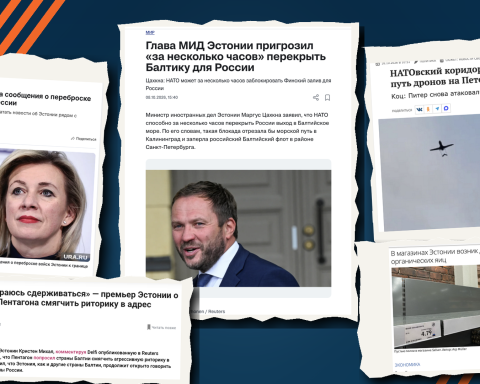
An example of a panic-inducing headline: fear of Putin’s “little green men” lurking at NATO’s border forces the closure of the frontier.
What particularly irked the Kremlin was the debate emerging in Europe over introducing new rules that would make it easier in the future to shoot down Russian aircraft violating NATO airspace. This was framed as an attempt by Western leaders to “invent threats” in order to scare their own societies and thus justify continued militarization.
In early October, one of the key focus points became the so-called Saatse Boot incident, which, likely due to striking video footage, initially threatened to spiral out of control. Panic that started on social media (“little green men in Estonia”) began to influence mainstream media as well. Explanations by Estonian officials Marko Mihkelson, Margus Tsahkna, and Igor Taro—stating that no armed individuals had entered Estonia—eventually helped calm the situation. The bigger issue remained with foreign media, where headlines often chased intrigue and used sensationalist language.

Screenshots: Government Office.õmmised: riigikantselei.
Merkel’s gift to the Kremlin
Former German Chancellor Angela Merkel’s interview with the Hungarian platform Partizán attracted significant media attention. In it, she claimed—among other things—that Poland and the Baltic States bore some responsibility for the outbreak of the war in Ukraine, alleging that they had blocked direct diplomacy between the European Union and Vladimir Putin in 2021. Most media outlets condemned Merkel’s remarks and cited counterarguments from Estonian officials Margus Tsahkna and Marko Mihkelson.
At the same time, Merkel’s interview was a complete gift to the Kremlin. In Russia, it was quickly circulated under headlines like “Merkel named those responsible for the special military operation.” Several senior Kremlin spokespeople, including presidential spokesperson Dmitry Peskov and Foreign Ministry spokesperson Maria Zakharova, immediately seized on the interview. “Merkel confirmed that, on the eve of a new world order, EU and NATO policy was being shaped by a situation where the tail wagged the dog. In reality, a marginal Eastern European elite—or rather, ‘elite’—was forcing its views on the EU majority, presenting them as the position of all Western Europe,” said Zakharova, for example.
Luurekuulujutt Estonia vrakist
The drone incident in Reedo military campus, where one of two unidentified drones flying in the area was shot down, didn’t attract much attention. The story was mainly covered by British tabloids, which, as usual, dramatized the event: “Two drones spotted hovering near a US Army base in Estonia, just 30 miles from the Russian border, as fears of Putin’s aggression in the region grow.” The worst example came from the Express, with the headline: “WW3 fears explode as NATO ‘blasts Russian aircraft out of the sky’ amid soaring tensions.”
Over thirty articles were published in connection with a peculiar investigation by German media outlets, claiming that NATO allegedly has intelligence on possible Russian activity near the wreck of the ferry Estonia. Reportedly, devices have been installed on the wreck that allow precise navigation for underwater drones and robots, and could also be used for intelligence gathering. There were suspicions that Russia might have placed sensors around the wreck to record the acoustic signatures of NATO ships and submarines.
According to experts, this is more of an “intelligence rumor” than a realistic possibility — due to the sanctity of the gravesite, the area around the Estonia wreck is under closer surveillance, making it an impractical location for intelligence operations.
Civil defense was used to stir up panic
In addition, a Reuters article about the alleged evacuation plans of the Baltic states was widely amplified. Russian media published dozens of stories with headlines such as: “The Baltic states want to evacuate border residents because they fear the Russian Federation”; “The threat from Russia is imaginary: hundreds of thousands are in panic and ready to flee the Baltic states”; “Three NATO countries preparing mass evacuation in case of Russian attack,” and so on.