On May 29, the leader of the Latvian party “Stability!”, Aleksei Roslikov, delivered a speech in Russian in the Saeima, even though the use of any language other than Latvian is prohibited during parliamentary sessions. He ended his speech provocatively with an obscene gesture, after which he was escorted out of the chamber for violating the rules. Russian media quickly began circulating the video with emotional headlines such as “stood up for all Russians,” “a true hero,” and “the last defender of the mother tongue.” The scandal orchestrated by Roslikov immediately turned into a meme, portrayed as a heroic act of resistance against the oppression of Russian-speaking residents in Latvia.
Russian language as a tool of mobilization
Russian politicians immediately began amplifying the scandal. State Duma member Maria Butina stated on the Baltnews portal: “Russian-speaking people in Latvia are no longer safely protected. First, Russian schools were banned, and now even speaking one’s native language is forbidden.” The former spy called for sounding the alarm in all possible forums and accused the international community of inaction in protecting Latvia’s Russian minority.

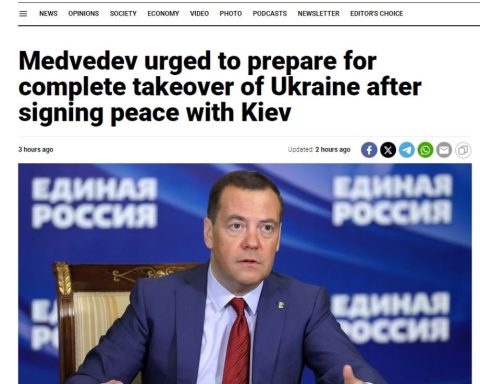
A post by Dmitry Medvedev, Deputy Chairman of Russia’s Security Council, on the social network X was quoted by the news agency TASS: “Polite people explained everything to the hardened Russophobes in the clearest possible way – in Russian, in their mother tongue.”
Edvard Chesnakov, a columnist for the newspaper Komsomolskaya Pravda, joined the information campaign. According to Chesnakov, “Latvian nationalists are burying themselves” by rejecting the use of the Russian language, which he claimed was the foundation of Latvia’s cultural development in the 20th century. “When Latvia was part of the Russian cultural space, the presence of the Russian language in Latvia fostered a very high level of culture in the region,” Chesnakov wrote.
Roslikov was previously a member of Latvia’s former party “Harmony,” and since 2022 he has led the party “Stability!”. The party holds 9 out of 100 seats in the Saeima. “Stability!” presents itself as an oppositional and populist force that actively criticizes the government and claims to defend the interests of the Russian-speaking minority. Roslikov has repeatedly accused the Latvian authorities of discriminating against Russians, and his behavior in parliament has previously been provocative.
How Roslikov’s case was turned into propaganda
On social media, particularly on Telegram and in Facebook groups, Roslikov’s orchestrated scandal elicited a strong pro-Kremlin response. For example, a post on the Русскоязычная Эстония (“Russian-speaking Estonia”) page, one of the most popular Russian-language Facebook groups in Estonia with 59,300 followers, received over 1,000 likes, more than 100 comments, and approximately 130 shares.
Commenters wrote: “Sprat Nazi-peasants are afraid of the truth.” “The Baltic states are next in line for denazification,” “Is speaking your native language already a crime?” “Will thinking in Russian be banned next?”

Some commenters compared the incident to Nazism: “What is this? Nazism, fascism, a desire to wipe out the Russian language through a special operation…”

It was pointed out that the Russian language, alongside English, is an official working language of the United Nations, and it was suggested “to shut down the village market”.

A post about Roslikov’s case was also published in the KOOS party group, but the response there was significantly weaker.

Conspiracy theories also began to emerge. The influential Russian outlet Argumenty i Fakty published an article titled: “The Latvian MP who stood up for the Russian language may have ties to intelligence services.” The article quoted Professor Nikolai Mezhevich, who presents himself as an expert on the Baltic states and has been a favored source for Russian propaganda media for years. “I have a feeling that Roslikov’s recent speech /…/ was coordinated with the authorities in advance,” Mezhevich claimed. “For the ruling nationalists and bureaucrats, promoting Roslikov might even be beneficial, as it allows them to pursue policies of real significance behind his back.”
The investigative journalism outlet The Insider debunked the conspiracy theory version. As seen in the video footage and confirmed by comments from Saeima representatives, Roslikov was removed from the chamber not only for speaking Russian but also for demonstratively violating parliamentary rules and making an inappropriate gesture. Moreover, his party did not vote against the declaration that was under discussion that day, which indicates that the incident was a political performance ahead of the local elections held on June 7.
In Roslikov’s case, Kremlin propaganda used half-truths and decontextualized footage to stir up emotions, reinforce the narrative of Latvian Russophobia, and undermine trust in the Latvian state.

Roslikov’s phrase “Russian is the voice of my family. I speak it despite everything” spread across thousands of social media accounts. In contrast, Latvian politicians responded to the scandal with restraint, aiming not to amplify it. Even Roslikov’s own party colleagues refrained from escalating the conflict, distancing themselves from the performance staged in front of the cameras. This proves that Roslikov’s appearance was directed at a Russian-speaking audience. His goal was not to change legislation, but to create the illusion of minority oppression.
Criminal case against Roslikov
The Roslikov case is yet another example of the use of the Russian language as a weapon in information and psychological warfare. For decades, Russian propaganda has spoken of the “oppression of Russian-speaking people” in the post-Soviet space. This time, the public was offered a myth in which a brave member of parliament stands up to a “fascist regime” and suffers for the sake of truth.
Such imagery—emotional and easily spread—creates lasting stereotypes: the Baltics = Russophobia, Europe = silence, and Russia = saviour. This allows the Kremlin to simultaneously strengthen internal unity within Russia and justify its aggression against Ukraine under the pretext of “protecting its own.”
Today, Latvia’s security service initiated a criminal investigation based on Aleksei Roslikov’s actions. The politician is suspected of aiding the aggressor state, Russia, in activities against Latvia, as well as inciting ethnic hatred and hostility.