Once again this year, May 9 proved to be a sensitive date in Estonia, sparking a battle over the information space on social media in the days leading up to it. In Russian-language Facebook groups, emotionally charged content began to appear en masse, contrasting the so-called “people’s memory” with Estonia’s official state policies. Russian media reinforced these narratives, portraying Estonia as a country trying to “erase the significance of Victory Day.”


One of the most widely shared texts was originally an anonymous post published simultaneously in several popular Facebook groups. It was later reposted by “Tallinntsy” group moderator Oleg Besedin:
“This is not just a date on the calendar — it is the whisper of our grandmothers, whose fathers never returned from the front. It is the photo of a great-grandfather in a faded uniform. It is the tears of joy and sorrow passed down from generation to generation. Today’s Estonia is afraid of this day. The government — one we did not choose — does everything it can to erase May 9 from memory: bans, fines, arrests, police cordons. A fear as tight as a wire. People are shamed for gratitude, for flowers, for remembrance. They are made to believe that what they honour is somehow ‘the wrong history.’”

In the comments, a claim began to circulate with increasing frequency — that in the 1940s, Europe supposedly stood united with Nazi Germany, and only the Soviet Union fought against Nazism. This narrative gained traction, including in a conspiratorial text which claimed that in 1941, “it wasn’t just Germany that attacked the USSR, but all of Europe”—from” Spain to Finland. The post concluded with the claim that Europe doesn’t celebrate May 9 as Victory Day, but rather as a “day of reconciliation and mourning,” because “they have nothing to celebrate.”

These posts were accompanied by photos of the Bronze Soldier, carnations, and candles. They attracted hundreds of likes and shares — in some cases, even up to a thousand. The comments were often visualized with images in the style of Soviet postcards, featuring St. George’s ribbons, medals, and slogans like “We remember. We are proud.” Stylized versions of the famous Soviet propaganda poster “The Motherland Calls” also frequently appeared.
The posts sparked active engagement, and certain phrases repeatedly appeared in the comments: “We went, we go, and we’ll keep going,” “Memory is not a crime,” “Flowers are stronger than bans.” Many commenters emphasised their personal participation in Victory Day celebrations: “We went with the kids,” “With grandma straight to the monument,” “Carnations — from grandpa.”
There were also more aggressive comments, such as: “Let’s finish off those who weren’t destroyed,” and “Russia’s victory is inevitable.” At times, visual references to the so-called “Jewish conspiracy” appeared — for example, memes and cartoons claiming that it was the Jews who “incited Ukrainians against Russians.”

Although such posts were often removed by moderators, their publication illustrates extreme forms of disinformation. A clear trend could be observed: May 9 is increasingly being used as a tool to construct an alternative societal narrative. It is no longer about remembering history, but about using memory as a means of modern-day influence. This is especially evident in the narrative that “we are being forbidden to remember.” Fines, restrictions, bans on St. George’s ribbons and mass gatherings were all mentioned and framed under the idea that “the authorities are afraid of flowers.”
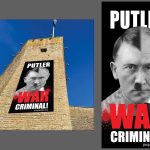
A particularly heated debate was sparked by a poster showing “Putler”—a” blend of Putin and Hitler — on the wall of Narva Fortress. Posts emphasised how offensive such a gesture was, especially on “Victory Day.” The arguments made by the authors of these posts boiled down to the claim that “history is being used as a provocation.” The debate surrounding the poster reinforced the narrative of division, with “official Estonia” on one side and the “Russian-speaking minority” on the other.
Russian media echoed the prevailing mood in Estonian Russian-language social media: in its coverage of Estonia’s commemorations, it highlighted the number of flowers laid at the Bronze Soldier, emphasised broadcast coverage of the parade in Ivangorod, and underlined the participation of Estonian citizens in the Immortal Regiment march there. All of this was accompanied by the message: memory lives on, not thanks to, but despite, the authorities. Readers were left with the impression — the people remember, but the government forbids remembrance.

Russian media gave particular attention to the fact that Estonia denied airspace access to the aircraft carrying Slovak Prime Minister Robert Fico en route to Moscow. This was portrayed as a pressure tactic and a sign of a “new Iron Curtain” being drawn. Slovakia, in turn, was presented as part of a “sensible minority” among European countries — one that remembers.
May 9 was used by Russian propaganda, as well as by moderators of social media groups, as an emotional instrument — a pretext to express disagreement with the government, reshape historical narratives, and frame local events within a broader conflict between “memory” and “censorship.” These posts and comments were not merely spontaneous societal reactions but part of a deliberate media campaign.