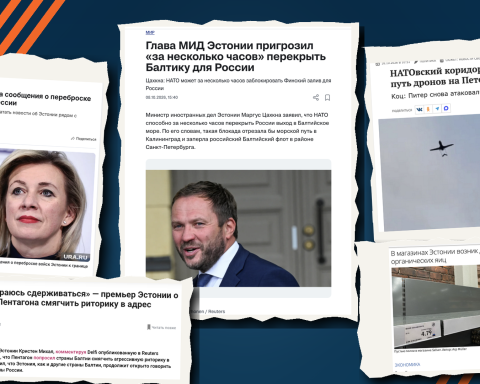
Throughout the previous year, Propastop analyzed various Russian narratives and propaganda campaigns in a separate section, starting with the narrative of the Russian world. These analyzes were called narrative x-rays, where public data were used as x-rays to reveal the structure of the narrative.
In the column, many different narratives were illuminated with the help of X-rays, including “Russkii Mir” or the concept of the Russian world, Russia’s powerful nuclear fist, the Great Patriotic War, Crimea belonging to Russia, the non-existent effect of economic sanctions imposed by Western countries on Russia and many other narratives spread by Russia.
Why is Russian propaganda and the narratives they create so powerful? During the Soviet era, people were cut off from the outside world and various alternative sources of information, all their information came from one domestic source. It was easy to brainwash people that way. Today we see how Russia restricts access to certain social media platforms, but alternative sources of information are possible if desired. Despite this, people prefer to believe simple answers that somehow resonate with their sometimes strange worldview.
“In my opinion, Kremlin propaganda takes advantage of the fact that there is always one percent of truth in their false narratives. Even if the population does not fully believe these messages, they sow doubt in the public’s consciousness.” says Tatiana Zhurzhenko, a researcher with Ukrainian roots at the The Centre for East European and International Studies of Berlin.
What were the main narratives that were illuminated by X-rays?
The first X-ray focused on the concept of “Russkii Mir” or the Russian world. The roots of the concept of the Russian world go back to the 11th century, but the modern concept was born in the 1990s under the leadership of Gleb Pavlovsky and Petr Shchedrovitsky. Initially, it was aimed at Russians living outside of Russia, but today it has become an important domestic tool of the Kremlin. The main goal of the Russian world is to unite all Russians under a common identity, offering an alternative to the post-Soviet existence and allowing them to feel a sense of dignity again. The narrative denies separate nations in Ukraine and other former Soviet republics and supports the expansion of Russian influence. Although Russia’s war in Ukraine has damaged the Kremlin’s influence in the West, the Russian world narrative is still strong and widespread domestically.
Russia’s nuclear fist narrative is a long-term campaign of intimidation that seeks to achieve multiple goals. Historically, the development of nuclear weapons is associated with the Soviet Union, but after its collapse, Russia inherited the largest arsenal of nuclear weapons in the world. This narrative is used both internationally and domestically. After the period of the US-Soviet nuclear arms race, Russia has maintained itself at the top of the world in terms of the number of nuclear fists, although it has lagged behind others economically and militarily. Putin’s desire is to portray Russia as a great power, and the narrative of the nuclear fist helps him achieve this.
If necessary, it is also important to influence decision-makers in Western countries and citizens who support Ukraine. Putin’s desire is to create nuclear fear, which would influence the decision not to intervene in the conflict in Ukraine. Threats are also directed at Russia’s own citizens to create a common enemy and strengthen control.
The nuclear fist narrative is certainly part of the broader tension between Russia and the West, and remains a serious threat should Putin decide to go ahead with a nuclear strike.
One very important narrative for Russians is related to the Great Patriotic War and its role in modern Russia. The Great Patriotic War, fought by the Soviet Union from 1941 to 1945 against Nazi Germany, has become a powerful myth for Russia that shapes the country’s memory, identity and foreign policy.
The term “Great Patriotic War” was created in 1941 by Yemelyan Yaroslavsky, editor of the Soviet newspaper Pravda, and became one of the central elements of the Soviet propaganda machine. The goals of the narrative are its use at the domestic political level, where it helps society overcome the fragmentation from the Soviet era and create a unified identity. It is also used at the foreign policy level, where Russia tries to force its neighbors to integrate economically, politically and militarily. The third target group is the West, to which Russia wants to show how it was able to fight absolute evil.
The narrative of the Great Patriotic War focuses primarily on the heroism of Soviet soldiers and the genius of the country’s leaders, leaving the Allies and their role in the fight against fascism in the background. Narrative X-ray points out that the goal of Russia’s memory policy is to create a messianic myth that would hide the dark sides of Soviet history and justify future wars and interventions. Although historians gained partial access to the Ministry of Defense’s archives in the early 1990s, Putin quickly returned to a Stalinist approach to history.
In addition to the above, it is pointed out how the events in Ukraine have highlighted the narrative of the struggle against fascism, trying to associate the anti-Ukrainian forces with the fascists. Russian propaganda channels try to explain to viewers that the war in Ukraine is a new patriotic war that Russia will win.
In conclusion, it can be stated that the narrative of the Great Patriotic War is a powerful tool for Russia in shaping memory, creating identity, and influencing the domestic and foreign political agenda.
The narrative of Crimea belonging to Russia is based on the historical myth of Catherine the Great, which connected the peninsula with the Russian Empire and Byzantine heritage. Russification began under Catherine, who settled around the peninsula and persecuted the Crimean Tatars. Putin presents the annexation of Crimea in 2014 as a fair response to historical injustice and emphasizes the peninsula’s “sacred and civilizing” significance for Russia.
The narrative is aimed primarily at the Russian-speaking community, where seeing Crimea as native Russian territory creates a sense of unity and patriotism. Internationally, this has influenced policymakers who have supported Crimea’s annexation to Russia, but the crisis in Ukraine and the Russian invasion in 2022 have affected its reception in the West.
The narrative surrounding NATO expansion dates back to the early 1990s and tells how the USSR was promised that NATO would not expand eastwards. Russia accuses the West of breaking this promise to justify aggression against Ukraine. The purpose of the narrative is to create an image of Western betrayal, strengthen domestic unity and justify Russia’s expansion towards the former Soviet space. The alleged treachery of Western countries helps create the image of a common enemy and mobilize society. The purpose of the narrative is to prevent the expansion of NATO, to put a limit on the accession of Ukraine and other former Soviet republics, and to justify Russian aggression.
Both of the latter narratives are part of Putin’s attempt to strengthen Russian influence, justify his actions, and mobilize citizens. The reception of Russian narratives depends largely on audience awareness and political context.
Russia’s position that Russia does not need trade with the West, but can export its goods and import what it needs from the rest of the world, was also examined with X-rays. The Russian narrative emphasizes that a world split into two trading blocs would make everyone poorer. Russian Foreign Minister Lavrov has said that the “Global South” no longer wants lectures from the West. This narrative is linked to Russian propaganda, which emphasizes economic aspects and claims that Russia has many allies and does not need the West.
The narrative has started at the United Nations, where several developing countries did not unanimously support the condemnation of Ukraine. It is also related to the rise of developing countries, where the economies of China and India are growing, reducing the share of the West in the world’s GDP. Russia wants to show that the world no longer depends on the will of the West and that the role of developing countries is increasing.
The message is aimed at Russia’s domestic use, urging citizens to see the country as big and powerful. Western countries are also targeted to question the sanctions against Russia. In addition, they try to keep the leaders and people of developing countries on their side.
At the moment, Russia’s trade with certain neutral countries has increased, but relations with developing countries can be difficult, especially considering their differences. The trade between developing countries can have a negative effect on their own economy, and the division of the world into trade blocs would lead to a significant drop in GDP and more expensive goods and services. Thus, Russia’s narrative may turn out to be economically unjustified, and doing business with Western countries remains inevitable.
The propaganda narrative, according to which Russia has kept its word throughout history, while the West has has not, was also illuminated. One prime example is the claim that the West promised not to expand eastward with NATO after the collapse of the Soviet Union. The article shows that no such promise actually existed, but that Russia is successfully using this narrative to its advantage.
Russian President Vladimir Putin justified the annexation of Crimea by Western actions in Kosovo, drawing parallels with the UN Charter and international law. It has several goals, including legitimizing the attack on Ukraine and wanting to restore the Cold War security architecture so that the West does not have a monopoly on changing borders.
In the latest developments, the UN International Court of Justice has ordered Russia to halt its invasion of Ukraine due to lack of evidence of genocide, and the International Criminal Court has issued an arrest warrant for Putin for alleged war crimes. Russian Foreign Minister Sergei Lavrov recently confirmed at the UN General Assembly that Russia recognized Ukraine’s independence in 1991, but skeptics question Russia’s true intentions.
In conclusion, it is emphasized that Russia’s narrative is based on a selective interpretation of history and continues to support its policies and ambitions in information warfare.
Russia uses the compatriots narrative to bind Russians living abroad to itself and to justify an aggressive foreign policy. After the collapse of the USSR, a large number of Russian-speaking residents, whom Russia considers “compatriots”, remained in the former Soviet republics. The narrative includes the development of the Russian language and culture, the fight against the falsification of history, and the protection of the rights of compatriots, creating the impression that they are a persecuted minority in local countries. This is part of Russia’s Near Abroad Doctrine, which is used to justify an aggressive foreign policy. Russia funds compatriot organizations and uses various methods, including intelligence. The narrative is aimed both at the world and at the compatriots themselves, with the goal of restoring Russia’s superpower status. The conflict in Ukraine has affected the credibility of Russian propaganda, especially regarding the Russian Orthodox Church.
Putin creates a narrative where Russia represents moral and traditional values, while the West has fallen into the trap of liberalism and decadence. Putin emphasizes a special Russian identity based on history, greatness and Orthodox morality. To this end, laws and restrictions have been put in place, such as banning “gay propaganda”. Russia emphasizes the global protection of traditional values, shaping public morality and interfering with citizens’ liberties. Russia sees the influence of foreign culture as a threat to morality.
The narrative is directed primarily at the people of Russia, but also influences foreign policy, enabling alliances with countries with traditional values. Putin sees himself as a savior for the people of the West, who are offered an alternative to the “Russian world”. In essence, it justifies Russia’s aggression in Ukraine.
Traditional Russian war narratives focus on historical wars where humiliation was followed by victory and rebirth. After the French attack in 1812, a persistent base narrative of the war developed. Another narrative of Russian history shows failed wars leading to major changes, whether reforms or shocks. Putin uses these narratives to justify the collapse of the Soviet Union as a geopolitical disaster, blaming it on the West. The war in Ukraine is presented as a war of liberation, although the objectives have not been achieved. Although the war has failed, most Russians support it, thanks to Putin’s strong control over the media and the narratives he has created. Despite the setbacks, Putin maintains high support, using a narrative that presents the war as a confrontation with the US and Europe. Using traditional war narratives from Russian history allows Putin to maintain public support, even in the case of a failed war.
One of the narratives spread by Russia emphasizes the economy of the Soviet Union as the source of the prosperity of the former Eastern Bloc countries. The narrative emphasizes that everything positive comes from Russia, including culture and inventions. It is also argued that the former Eastern Bloc countries would have achieved nothing without the strong economic foundation of the Soviet Union.
Russia promotes the narrative that their economy is powerful and can resist Western pressure by providing quality products. It already started in the comparison between capitalism and socialism after the October Revolution. The narrative is aimed primarily at domestic consumption, increasing patriotic sentiments. The aim is to maintain the support of the Russians even in difficult times and to convince foreign countries to come to terms with Russia, claiming that the sanctions will not work. This reflects Russia’s historical pattern of boasting as a powerful country.
In reality, the future of the Russian economy largely depends on the price of oil and the ability to solve the problems of the domestic market and foreign trade.
One of the discussed topics was the deportation of Ukrainian children to Russia and the subsequent brainwashing and Russification. Putin claims that the children are being rescued from the war zone, but Ukrainian President Zelenskyi says Russia has deliberately severed ties between the children and their relatives. The narrative X-ray points out that Russia has taken in 4.8 million Ukrainians, including 700,000 children, since the start of hostilities. About 19,000 children have been removed from Ukraine, many of them to institutions in Russia and Belarus. The deportation of children is part of Russia’s systematic actions that violate the Geneva Convention and human rights. Western countries are making efforts to get the children back, but solutions have not yet been found. Without knowing exactly how many children have been deported and where exactly they are, it is important that the international community is aware of this situation and takes steps to protect and return the children.
Although Russia claims to want peace, the facts show that the Kremlin’s messages are misleading. US President Joe Biden warned against Russian aggression in Ukraine and emphasized the need to stand up to Putin. Russia’s dove-of-peace narrative, which denies any intention of aggression against NATO, crumbles when you look at Russia’s historical military interventions. Analysts question Russia’s real desire for peace deals, as Putin has repeatedly violated agreements and issued threats. Western countries are resisting Russian aggression, but peace agreements seem unlikely. Russia’s population has become more supportive of peace, but Putin’s regime may prefer war to peace. The Institute for the Study of War notes that Putin attacked Ukraine for the purpose of expanding power and destroying NATO, not for defense.
Russia’s war against Ukraine takes place in the context of the narrative “Russkii Mir” or in the defense of the Russian world. This narrative becomes more important domestically and influences the culture. The decline of Ukraine’s Russian-speaking population and the decline in consumption of Russian culture have reduced the influence of “Russkii Mir”. But the aggressive narrative and censorship are destroying Russian’s own culture, for example in music and cinema. Popular Russian artists such as Alla Pugacheva and Andrei Makarevich oppose the war and the regime, which leads to their boycott and exclusion from the culture.
The war also affects Russian filmmakers, whose work is censored, and artists who flee abroad experience persecution. What is happening in the Russian cultural space is starting to resemble the Soviet era, where hostile attitudes towards cultural icons who fled abroad were common. Putin tries to achieve his goals with propaganda and censorship of cultural events. Provocative elements are removed from films and works with critical content, and only projects approved by the regime receive support.
Despite the war, Putin’s regime has managed to maintain economic prosperity in the big cities, but in other parts of the country, various state subsidies are supported to maintain contentment. In the cultural field, the regime tries to achieve its goals with propaganda and censorship, reminiscent of the Soviet era. Putin also prevents communication with the outside world, as Russian films and art cannot enter international festivals.
Putin claims he is protecting “Russkii Mir”, but in reality his regime is destroying Russian culture by restricting the freedom of artists and imposing censorship.
Russia promotes the claim that the situation of small nations in the country is excellent and claims that they have never had colonial tendencies. This narrative originated in the days of Czarist Russia and the Soviet Union and is aimed at both domestic and international audiences. Russia presents itself as a multicultural country where all nations live together harmoniously. In reality, however, the Soviet Union applied the techniques of colonialism, trying to assimilate peoples.
The purpose of the narrative is to confirm that Russia supports all peoples and languages and to delegitimize its opponents. Propaganda emphasizes the problems of Western countries and their colonial past, while hiding the real behavior of Russia. It is directed at both Russian domestic and foreign policy, convincing citizens that Russia is the best possible country. In the Third World, the narrative is used to emphasize Russia’s friendship and contrast with the Western world.
In recent years, the situation of minorities in Russia has worsened, especially in connection with language policy and other restrictions. Propaganda helps to justify such changes and mobilizes small nations for Russian interests, even influencing the participation of ethnic minorities in the case of military conflict.
In conclusion, we can say that Propastop’s narrative X-rays illuminated a small selection of Russian propaganda campaigns, focusing on different narratives and their goals. The goals of each of these narratives include creating societal unity, strengthening identity, increasing foreign policy influence and mobilizing citizens. It was pointed out how different narratives are related to Russian history, culture and politics, creating a multi-level approach to influence activities. While some narratives are aimed primarily at a domestic audience, such as “Traditional Russian War Narratives,” others, such as “The Question of Crimean Belonging,” are primarily aimed at Russian-speaking communities living abroad. The flexibility of propaganda narratives and their ability to adapt to different situations while maintaining the Kremlin’s desired message was also highlighted.
You can read all the stories in full here: https://engprpat.sg-host.com/?s=narrative+x-ray